
GPT-6 Astra, Higgsfield and Blender: The Rise of Production AI
For the past few years, generative AI has largely been a machine that produces pieces. Ask for an image and it creates an image. Ask for some code and it gives you code. Ask for a video and, after a few unpredictable attempts, you might receive several seconds of footage that look impressive enough to post online. GPT-6 Astra, Higgsfield and Blender point toward something considerably bigger: AI that can participate in an entire production pipeline.
This is why recent demonstrations have attracted so much attention. People are no longer showing AI-generated pictures in isolation; they are using AI to plan projects, generate 3D assets, build scenes, animate characters, position cameras, produce cinematic footage and create playable environments. Tasks that once required several specialists and multiple disconnected programs can increasingly be coordinated through a conversation.
That does not mean someone can type “make the next Grand Theft Auto” and receive a finished billion-dollar game before lunch. The most spectacular demonstrations are carefully selected, and professional work still requires testing, revision and human judgment. Nevertheless, something important has changed: AI is beginning to move from content generation into production management.
What Is Production AI?
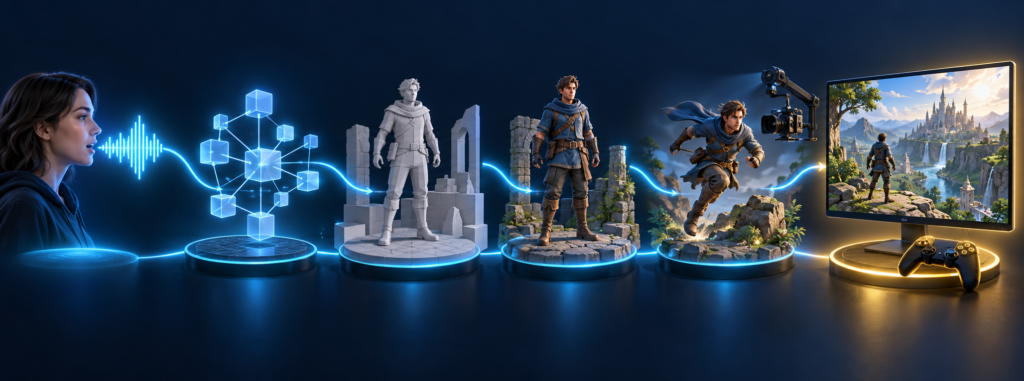
Production AI describes a system that can help complete a connected sequence of creative or technical tasks instead of generating only one isolated result. It might research an idea, develop a concept, create the required assets, operate professional software, inspect the result and revise what went wrong. The important development is not merely that each individual AI model has improved, but that models can now use tools and exchange information across an entire workflow.
Consider the difference between generating a picture of a medieval castle and constructing a castle inside a 3D application. The picture is a finished collection of pixels. A proper 3D scene contains walls, towers, terrain, materials, lights and cameras that can all be selected and changed independently. The castle can be viewed from another angle, damaged in an animation, placed inside a game or lit differently without recreating the entire project.
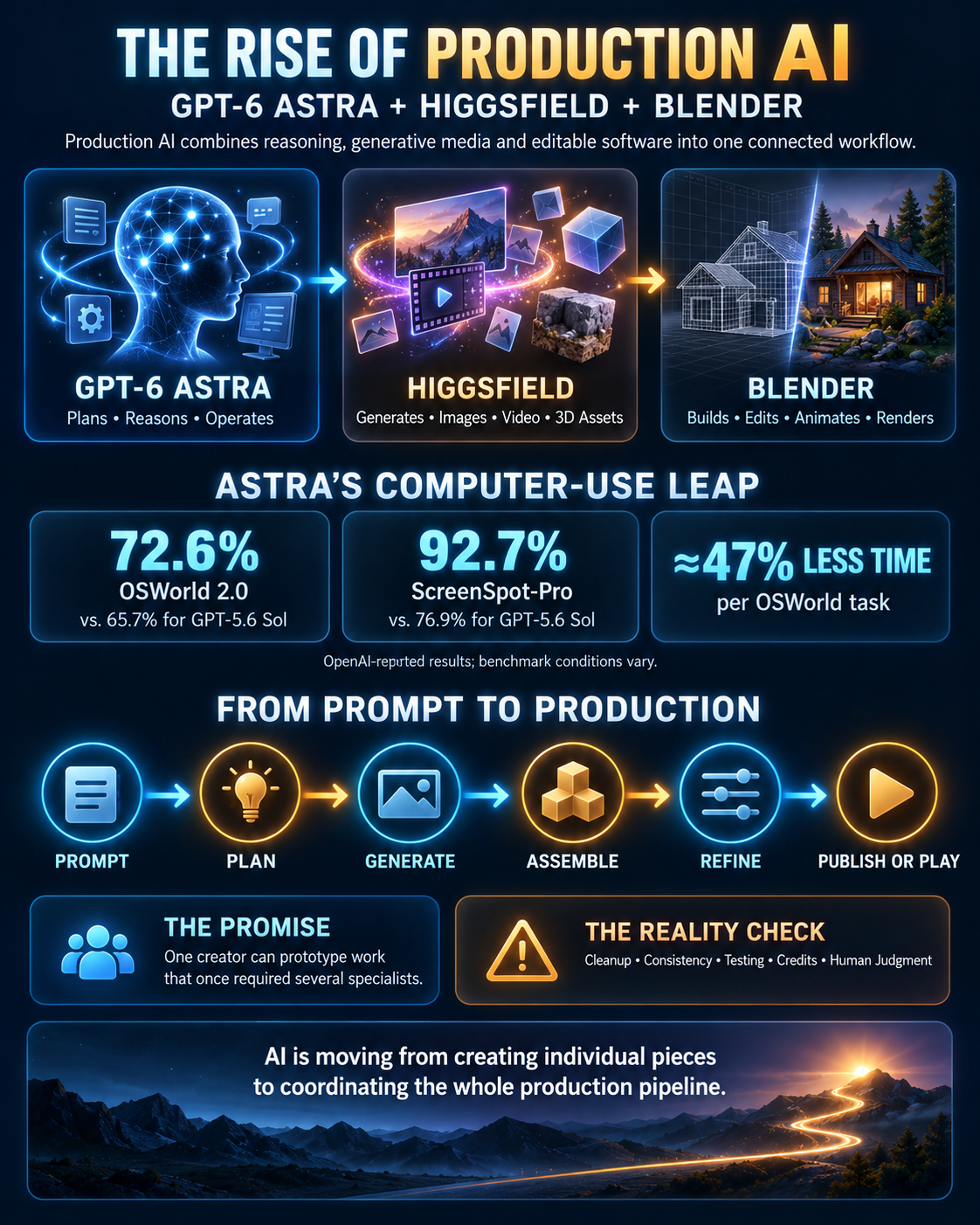
Production AI attempts to bridge those worlds. A reasoning model such as GPT-6 Astra can interpret the goal and coordinate the work, while specialized services such as Higgsfield generate visual material. Blender provides the structured workspace where that material can be assembled, inspected and edited. Each part performs a different job, and the impressive results come from combining them.
GPT-6 Astra: The Director Behind the Workflow
GPT-6 Astra is OpenAI’s newest frontier model, but its most consequential improvement may not be its ability to produce better answers. Astra is designed to work more effectively with computers, browsers, software and other tools. That makes it less like a highly knowledgeable chatbot and more like a digital operator that can carry a complicated assignment through multiple stages.
According to OpenAI’s GPT-6 Astra announcement, the model has improved substantially in computer use, software engineering, visual judgment and professional work. On OpenAI’s reported OSWorld 2.0 testing, Astra scored 72.6 percent compared with 65.7 percent for GPT-5.6 Sol, while completing the simulated tasks in approximately 47 percent less time. OpenAI also reports a ScreenSpot-Pro score of 92.7 percent, compared with 76.9 percent for Sol, suggesting that Astra is considerably better at understanding what is happening on a screen.
Those numbers matter, but the practical changes are more interesting than the benchmarks. Astra is better at interpreting incomplete instructions, deciding which routine details it can handle and recognizing when it needs to ask the user a meaningful question. It is also better at staying oriented when a project changes direction, rather than forgetting the original goal as new instructions arrive.
This is particularly useful in creative production, where the first result is rarely the final result. A user might ask Astra to build an abandoned industrial building, then request larger windows, more realistic lighting, a damaged roof and enough open floor space for a playable combat sequence. A less capable model may treat each instruction as a disconnected request. A stronger agent must understand that every revision belongs to the same scene and that changing one element can affect lighting, navigation, camera placement and performance.
Astra has also improved at coding and long-running technical work. Inside Codex, it can preserve notes and search earlier context after a conversation grows beyond its immediate context window. That may sound less exciting than generating a dramatic 3D world, but losing track of requirements is one of the main reasons complicated AI projects fall apart. Better continuity allows the model to remember what was attempted, what failed and which decisions must remain unchanged.
What Is Higgsfield?
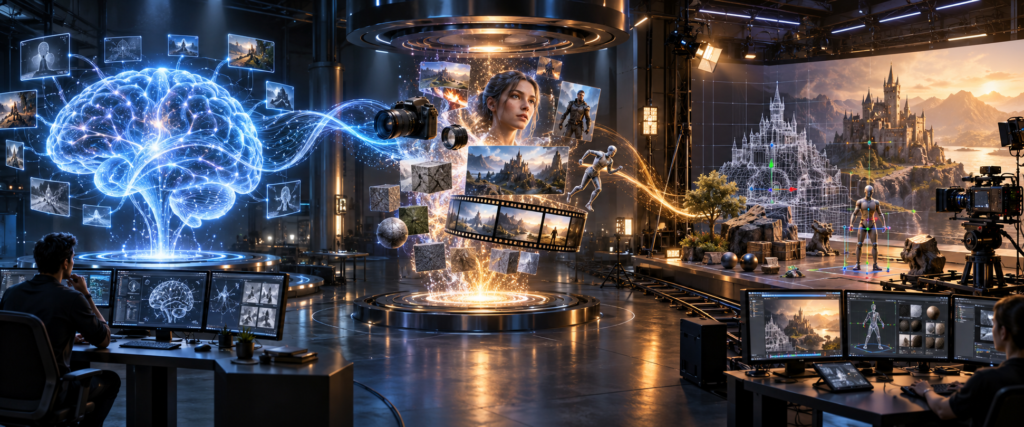
Higgsfield is an AI-native creative platform focused on images, videos, visual effects, animation, advertising and other forms of digital media. It is not simply one image generator or one video model. The platform provides access to multiple creative models and packages them into workflows for cinematic video, marketing, user-generated-style advertisements, motion graphics, character creation and visual editing.
Higgsfield can create media from a text prompt, a reference image or a combination of the two. Its tools include camera-motion presets, image editing, video effects, motion transfer, character consistency features and generative models for images, video and 3D assets. Genjutsu, for example, is designed to transfer motion into a different scene or replace selected details while preserving the rest of the original footage.
Higgsfield also offers a ChatGPT plugin that allows a user to request images and videos without leaving the conversation. ChatGPT can help develop the concept, write a script, choose a format and prepare the generation instructions, while Higgsfield performs the specialized media generation. The service uses Higgsfield credits, with the cost depending on the model, resolution and type of generation selected.
This division of labour is worth understanding. Astra is not secretly performing every visual calculation itself, and installing the Higgsfield plugin does not merge the two companies’ models into one giant intelligence. Astra acts as the planner and coordinator, while Higgsfield supplies specialized creative engines that the AI can call when the project requires them.
What Is Blender?
Blender is a free, open-source 3D creation application used for modelling, sculpting, materials, lighting, rigging, animation, simulation, rendering, motion tracking, compositing and video editing. It has been used by individual artists, animation studios, game developers, architects and visual-effects creators for years. It is powerful enough for professional production, but it also has a notoriously dense interface and a substantial learning curve.
Unlike a generative video service, Blender gives creators access to the actual construction of a scene. A chair is not merely part of a flat image; it can exist as an editable 3D mesh with dimensions, materials and a position in space. A character can contain a skeleton, known as a rig, that allows individual limbs to be posed and animated. Lights and cameras can be moved just as they would be on a physical set.
This structure provides consistency and control that pure video generation often struggles to maintain. If a creator needs the same room from six angles, Blender can keep the room’s layout consistent because all six shots use the same underlying scene. If the table is moved two metres to the left, every subsequent camera angle can reflect that change. The creator does not need to repeatedly ask a video model to remember what the room looked like.
Blender can also use Python scripts and add-ons, making it unusually suitable for AI automation. An agent can potentially create objects, change numerical values, arrange a scene or run repetitive operations by issuing commands rather than manually clicking through every menu. This does not make Blender simple, but it gives an AI system more direct ways to interact with it.
How Higgsfield Connects AI to Blender
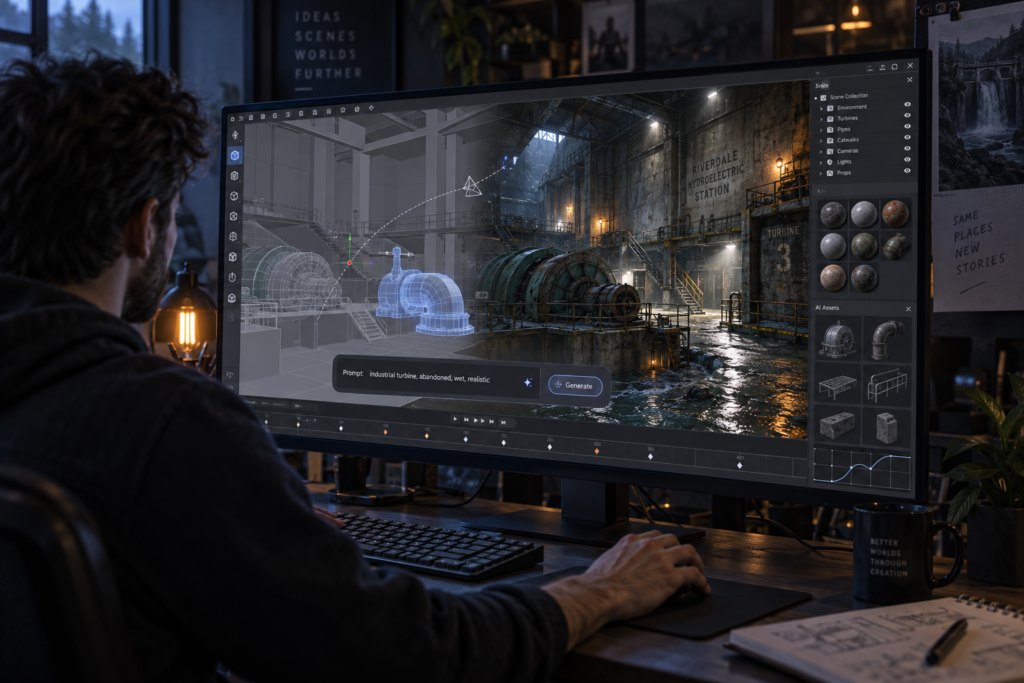
The Higgsfield add-on brings generative tools directly into Blender’s 3D viewport. Instead of leaving Blender, visiting an AI website, generating an asset, downloading it and importing it manually, the creator can request material from within the project. Higgsfield organizes these capabilities into tools for scene building, 3D models, character animation, images, video, cameras and assets.
Its Scene Builder is especially significant. Higgsfield says it can create actual objects, lighting and layout inside the open Blender file rather than returning only a picture of the requested environment. The resulting geometry can be moved, resized, deleted or replaced like other Blender content. Generated 3D models arrive as editable objects, while images can be inserted as planes or connected to materials.
Character animation can include a fitted rig, weights and timeline keyframes. These are standard Blender components, so a knowledgeable user can adjust the animation curves instead of throwing away the result and generating everything again. Higgsfield’s cloud handles its AI generation, although the user’s own computer still performs Blender’s native viewport work and local rendering.
The Higgsfield Bridge then allows a connected AI agent to communicate with the add-on. According to the official Higgsfield Blender page, a creator can connect an agent and request something such as a calibration-bay blockout in Blender. The agent can coordinate the request while Higgsfield supplies assets and the Blender add-on places them into the scene.
From One Prompt to an Editable World
Imagine asking for a cinematic scene set inside an abandoned hydroelectric station after a global power failure. The building should contain corroded turbines, emergency lights, ankle-deep water and a partially collapsed control room. A lone character enters through a maintenance tunnel while a camera follows from behind.
A production-AI workflow could divide that request into several connected stages:
- Astra interprets the concept, identifies the required assets and creates a production plan.
- The scene-building tools establish the room dimensions, major objects, lighting and camera layout.
- Generative 3D tools produce turbines, pipes, control panels, debris and environmental props.
- Materials add rust, wet concrete, peeling paint and reflective water surfaces.
- Character-animation tools generate or adapt the movement through the environment.
- Higgsfield’s video models can transform the blockout or rendered reference into more cinematic footage.
- Astra reviews the result, identifies problems and coordinates another round of changes.
- The finished environment can remain in Blender or be exported to a game engine for interactivity.
None of those steps is completely new on its own. Artists have been using Blender to build scenes and video generators to create footage for years. What is new is the possibility of controlling more of the sequence through natural language while maintaining a connection between the stages.
This also helps explain why 3D can improve AI video workflows. Generating an expensive video clip from a vague text prompt can produce the wrong camera angle, incorrect object placement or impossible motion. A rough Blender scene lets the creator establish composition, timing and camera movement before spending credits on the final generation. Even an unattractive grey-box model can provide useful spatial guidance.
Why These Demonstrations Fascinate People
The excitement comes from watching several technical barriers collapse at once. A person who cannot model a complex object from scratch may still be able to describe it, generate a usable starting point and modify the result. Someone who does not understand every part of Blender’s interface can ask an AI agent to perform routine operations while gradually learning how the underlying scene works.
OpenAI demonstrated Astra creating a house in Blender and turning it into a walkable scene in Unreal Engine 5. Higgsfield has promoted workflows that transform a prompt into a playable 3D game containing a story, mechanics and generated assets. These demonstrations suggest that AI is beginning to cross the gap between describing a product and actually assembling one.
For independent creators, that is a powerful proposition. A solo filmmaker could use the same general system for storyboarding, environments, background footage and visual effects. A product designer could move from a verbal concept to a rough 3D presentation, while a small business could create advertisement variations without coordinating several separate contractors.
The potential applications already extend well beyond entertainment:
- Rapidly prototyping game levels, characters and environmental assets
- Visualizing renovations, rooms, products or architectural concepts
- Creating animated explainers and educational demonstrations
- Producing cinematic advertisements and social-media campaigns
- Building virtual sets for independent films and online videos
- Developing interactive product demonstrations and training simulations
The real attraction is not that AI suddenly possesses the taste of an experienced director or the precision of a professional 3D artist. It is that a motivated person can explore ideas that previously required software expertise, expensive labour or weeks of preparation. The first draft becomes dramatically cheaper and faster.
The Skeptical View: A Great Demo Is Not a Finished Production
This is where the excitement requires some restraint. Technology demonstrations are designed to show the system at its best, not the average result after an inexperienced user writes an unclear prompt. Companies can select successful generations, shorten waiting periods and avoid showing the discarded attempts that came before the polished example.
Generated 3D models can contain messy geometry, inefficient polygon counts or materials that look good from only one angle. Character rigs may deform incorrectly, animation can produce sliding feet and environmental assets may not share a consistent scale. These problems are manageable for an experienced Blender user, but a beginner may not immediately understand what needs repairing.
Video generation introduces another layer of uncertainty. Characters can change appearance, objects can disappear between frames and physically impossible motion may be hidden behind impressive lighting. Producing a convincing eight-second clip is very different from maintaining continuity across a five-minute sequence. The longer and more interactive the project becomes, the more opportunities there are for small errors to compound.
A playable game presents even greater demands. Assets and scenery are only part of a game; it also needs controls, collision detection, physics, artificial intelligence, menus, sound, progression, performance optimization and extensive testing. Astra may help create and debug these components, but “playable” does not necessarily mean balanced, original, reliable or ready to sell.
Cost is another consideration. Blender itself is free, but cloud-based image, video and 3D generation consumes credits. Repeated experiments at higher resolutions can become expensive, particularly when many results are discarded. A creator still needs to understand where AI generation saves time and where a small manual adjustment would be faster and cheaper.
There are also questions surrounding originality, commercial rights and creative dependence. Paid services may permit commercial use, but creators must still consider trademarks, recognizable people, copyrighted references and the terms attached to individual models. Depending too heavily on a cloud platform can also create problems if prices, credit systems, models or access rules change.
Why Production AI Matters Now
The shift toward production AI changes what it means to be technically capable. Previously, the advantage belonged largely to people who knew how to operate every tool themselves or could afford a team of specialists. The emerging advantage belongs to people who can clearly define an outcome, judge the quality of the result and guide several tools toward it.
This may create more opportunities for small teams and solopreneurs than earlier generations of AI. A single creator can test a product visualization, game idea or advertising concept without immediately committing thousands of dollars. If the idea works, specialists can refine it; if it fails, the experiment ends before consuming months of labour.
However, lowering the barrier to production also means that more mediocre content will be produced. When almost anyone can generate cinematic footage, cinematic footage alone stops being impressive. Storytelling, taste, credibility and a clear understanding of the audience become more valuable precisely because the mechanical part of creation is becoming easier.
The strongest creators will probably not be those who surrender every decision to an AI agent. They will be the people who know when to accept a result, when to revise it and when the model is confidently producing nonsense. Production AI rewards direction rather than passivity.
Final Verdict: Is This Really the Future of Creative Production?
GPT-6 Astra, Higgsfield and Blender do not form a magic button that replaces an entire studio. Astra provides reasoning, coordination and software operation. Higgsfield provides rapid image, video, animation and 3D generation, while Blender provides the editable structure and precision needed to turn generated material into a controllable project.
Together, however, they represent something more important than another incremental improvement in AI imagery. They show how conversational AI can become the control layer for an interconnected production system. A creator can begin with an idea, move into structured 3D work, generate specialized media, inspect the result and continue revising without treating every step as a separate project.
The hype will inevitably run ahead of reality, and many “one-prompt” creations will require more work than their demonstrations admit. Even so, the direction is difficult to ignore. AI is no longer satisfied with making one piece of the production—it is learning how to participate in the whole pipeline.