
5G, 6G and the Surveillance State: How Wireless Networks Work, What the Health Evidence Says and What Comes Next
Something about the rollout of modern wireless networks makes people uneasy. New antennas appear on rooftops, utility poles and towers. Governments auction invisible sections of the radio spectrum for billions of dollars. Telecommunications companies spend enormous amounts upgrading networks that, from the average phone user’s perspective, may already seem perfectly adequate. Before many people fully understood 5G, companies and governments were already discussing 6G. It is understandable that some people look at this rapid expansion and wonder whether faster mobile internet is really the entire story.
The suspicion became particularly intense during the COVID-19 pandemic, when claims spread online that 5G signals caused the illness, weakened the immune system or somehow helped transmit the virus. Those particular claims have no credible biological or technical foundation. Health Canada states that there is no scientific basis linking 5G networks with COVID-19, and radio waves cannot carry or manufacture a respiratory virus.
That does not mean every concern surrounding next-generation networks is foolish. Wireless infrastructure can support widespread data collection, connected cameras, location tracking, autonomous machines and billions of Internet of Things devices. The real questions are not simply, “Is 5G radiation secretly giving people COVID?” They are: How much information will these networks collect? Who will control it? How secure will it be? Will governments or corporations gain surveillance capabilities that citizens never meaningfully agreed to?
Those are legitimate questions. To answer them properly, however, we first need to understand what 3G, 4G, 5G and 6G actually are.
What Does the “G” in 5G and 6G Mean?
The letter “G” simply means “generation.” A new wireless generation is not one individual frequency, one particular antenna or one mysterious type of radiation. It is a collection of technical standards governing how phones, towers and network equipment communicate.
Each generation usually changes several parts of the system, including the radio interface, network architecture, frequency bands, antenna technology, security protocols, data capacity and how efficiently available spectrum is used. The transition is also gradual. A carrier may install new radios and antennas on an existing tower, upgrade the fibre connection running to that tower, replace software inside its core network and continue operating older equipment alongside it.
That is why the phrase “5G tower” can be misleading. The metal structure itself may have existed for twenty years. What makes a location 5G-enabled is normally the antenna, radio equipment, network software and spectrum being used—not necessarily the construction of a completely new tower.
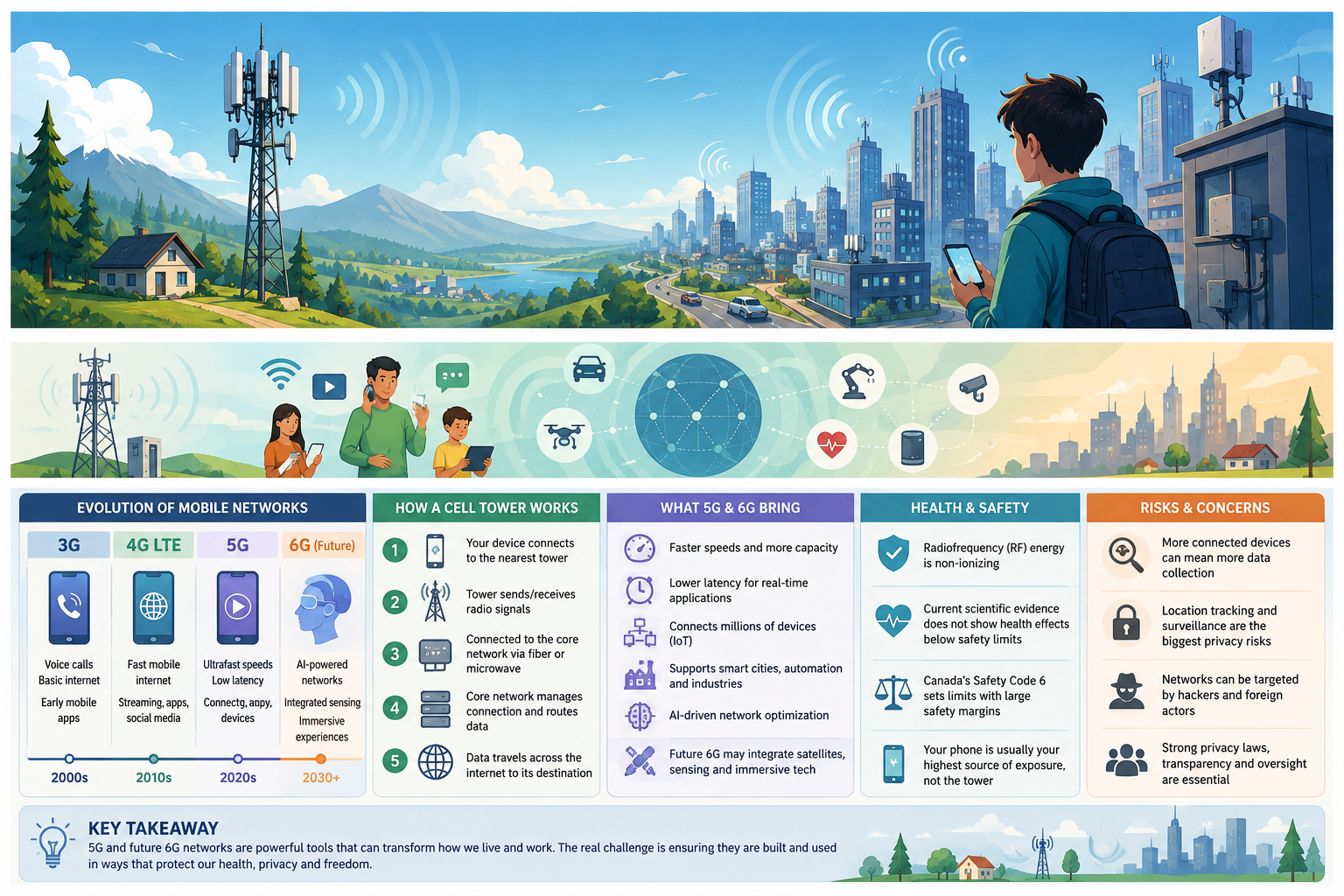
From 3G to 6G: What Actually Changes?
3G: Mobile Internet Becomes Practical
Third-generation networks became widespread during the 2000s. They made web browsing, email, picture messaging, early video calling and basic smartphone applications practical on a mobile device. Compared with modern networks, 3G was slow and inefficient, but it transformed the phone from primarily a voice-and-text device into a portable internet terminal.
Many carriers have since shut down or begun retiring their 3G networks. Spectrum is finite, so operators often repurpose frequencies previously used for older systems and use them for more efficient 4G or 5G service.
4G: The Smartphone Era
Fourth-generation LTE networks introduced a much more internet-centred architecture. Voice calls could be treated as internet data, while streaming, social media, mobile gaming, navigation and high-definition video became normal activities.
For most everyday users, 4G remains perfectly capable. A strong LTE connection can stream video, browse websites, use maps and handle video calls without obvious difficulty. This is one reason people reasonably ask why another generation is necessary.
The answer is that carriers do not design networks only around whether one individual can load a webpage. They must handle the combined traffic of thousands of people, vehicles, cameras, businesses and connected devices in the same area. A network may feel fast at 6:00 a.m. but become congested during a concert, emergency, sporting event or rush hour.
5G: More Capacity, Lower Delay and More Connected Machines
Fifth-generation technology was designed around three broad goals: faster mobile broadband, communications requiring high reliability and low latency, and the ability to connect very large numbers of machines and sensors.
5G can use several portions of the radio spectrum:
- Low-band spectrum travels relatively far and penetrates buildings effectively, but does not provide the greatest speeds.
- Mid-band spectrum offers a compromise between coverage and capacity. Canada has identified bands around 3,500 and 3,800 MHz as important parts of its 5G strategy.
- High-band or millimetre-wave spectrum can carry large quantities of data but has a shorter practical reach and is more easily blocked by walls, foliage and other obstacles. Canada has been preparing additional millimetre-wave spectrum for future wireless use.
Another major development is massive MIMO, meaning multiple-input, multiple-output. Instead of relying on a relatively simple antenna broadcasting energy broadly across an area, a modern antenna array can use many individual elements to communicate with several devices and shape radio energy more precisely. This is commonly described as beamforming.
5G also introduces network slicing. A carrier can create multiple logical networks over shared physical infrastructure, with each “slice” configured for different requirements. A hospital system might require high reliability, a factory may need extremely low latency, and ordinary consumers may need high download capacity.
6G: Still Being Designed, Not Secretly Deployed
Despite online posts about “6G towers,” commercial 6G service does not presently exist. As of August 2026, 6G remains in the research, requirements and standardization stages. The International Telecommunication Union calls the future system IMT-2030 and expects candidate radio technologies to be submitted between 2027 and 2029. Meanwhile, 3GPP is conducting early studies on 6G scenarios, architecture, security and radio requirements.
In other words, telecommunications companies are not currently covering cities with a completed, secret 6G network. Some existing sites may be used for experiments, research or equipment marketed as “6G-ready,” but the final global standard has not yet been completed.
Current plans suggest that 6G could combine conventional communications with:
- AI-assisted network management
- Satellite and other non-terrestrial networks
- More precise positioning
- Immersive communications
- Large-scale machine connectivity
- Improved rural and remote coverage
- Integrated sensing and communications
- Potential use of frequencies above 100 GHz in some applications
The ITU’s 6G framework includes integrated sensing and communication, meaning future radio systems may potentially communicate while also detecting information about objects or movement in their environment. Canada’s current spectrum planning similarly discusses AI-driven optimization, non-terrestrial networks and integrated sensing as possible 6G capabilities.
This sensing capability deserves serious privacy discussion. It is not evidence of a hidden mind-control system, but it could create networks that understand their physical surroundings far more precisely than today’s mobile systems.
How Does a Cellular Tower Actually Work?
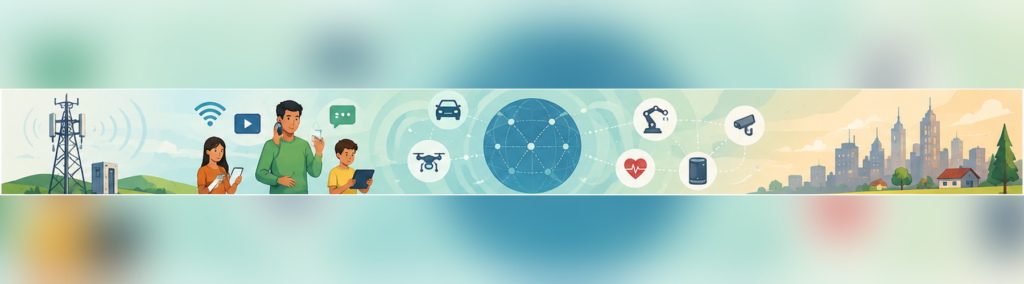
A cellular network divides a geographic region into coverage areas called cells. Each cell is served by a base station, although one physical site usually contains multiple antennas aimed in different directions.
When your phone connects, several things happen:
- The phone identifies an available network and authenticates itself using information associated with its SIM or eSIM.
- Your phone and the base station exchange radio signals.
- The base station connects to the carrier’s wider network, generally through fibre-optic cable or a point-to-point microwave link.
- The carrier’s core network authenticates the subscriber, manages the connection and routes calls or internet data.
- As you move, the network transfers your connection from one cell to another through a process called handover.
A tower is therefore not the internet itself. It is an access point connecting wireless devices to a much larger system of fibre, data centres, routers, switching equipment, authentication services and internet connections.
Modern sites can also adjust resources according to demand. Radio beams may be directed toward active devices rather than continuously radiating maximum power equally in every direction. Your phone also changes its own transmitting power. Health Canada notes that phones are designed to operate at the minimum power necessary to maintain a connection and may transmit at greater power when they are farther from a suitable tower.
Why Install More Antennas When Mobile Data Already Works?
This is one of the strongest questions critics ask. For many people in urban and suburban Canada, 4G already worked well enough. A new generation does not always produce a dramatic improvement when checking email or watching an ordinary video.
In fact, the CRTC reported in 2026 that average Canadian mobile speeds had largely plateaued since 2023, even after extensive 5G deployment. It also reported that latency remained relatively stable during the rise of 5G. That does not mean the network did nothing; increased capacity may allow more users and more data without a corresponding decline. However, it does show that marketing promises do not always translate into a revolutionary everyday experience.
The main reasons for continuing to expand infrastructure include:
- Mobile data consumption keeps increasing.
- More people carry multiple connected devices.
- Rural and highway coverage still has substantial gaps.
- Higher frequencies often require more densely placed antennas.
- Older network equipment eventually becomes inefficient or unsupported.
- Businesses want private wireless networks, automation and connected machinery.
- Carriers compete through coverage, capacity and advertised speed.
- Governments view telecommunications as critical economic and national-security infrastructure.
CRTC figures show that average monthly mobile data consumption in Canada more than doubled between 2020 and 2024. Although 5G was available to approximately 94 percent of Canada’s population by 2024, rural communities, First Nations reserve areas and the territories remained less well served.
Your connection may work perfectly because you live or travel in an area where carriers have already spent heavily. That experience does not necessarily represent an isolated highway, remote community, crowded stadium, industrial plant or major emergency.
How Much Does This Infrastructure Cost?
Telecommunications infrastructure is extremely expensive. Costs include radio equipment, antennas, tower construction or leasing, fibre backhaul, electricity, maintenance, software, data centres, cybersecurity, spectrum licences and the labour required to design and operate the system.
The CRTC reported that Canadian telecommunications operators invested a cumulative $64.4 billion in their networks between 2020 and 2024. That figure includes fibre and broader network infrastructure, not only 5G towers. In 2022 alone, approximately $1.3 billion of Canadian wireless capital spending was identified specifically as 5G investment.
This does not prove a sinister motive. Telecommunications companies operate in a market worth tens of billions of dollars annually, and network capacity is the foundation of their business. Canadian telecommunications services generated $59.6 billion in revenue during 2024, with mobile services accounting for more than half of the total.
There are still valid policy questions. Should companies be encouraged to extend service into underserved regions instead of endlessly increasing capacity in profitable urban markets? Are customers receiving meaningful improvements for the money being spent? Are spectrum auctions and infrastructure policies benefiting the public or mainly protecting a small number of dominant carriers? Those are reasonable concerns without requiring a secret radiation plot.
How Many Towers Will Be Installed, and How Close Together?
There is no single global plan requiring every tower to be a particular distance apart. Placement depends on terrain, buildings, population density, spectrum, antenna height, available fibre, local regulations and expected demand.
Low-frequency signals can serve larger areas, so rural networks may use fewer, taller macro sites. Dense cities require more capacity, meaning carriers may install rooftop antennas, pole-mounted units and low-powered small cells. High-frequency signals generally do not travel or penetrate obstacles as effectively, creating pressure for denser infrastructure when those frequencies are used.
More antennas do not automatically mean that every antenna operates at high power. Small cells generally use lower power because they serve a smaller area. Regulators require the combined exposure from installations accessible to the public to remain within applicable limits.
The CRTC says future 5G improvements can still come through densification, meaning additional spectrum and antennas in high-demand areas. However, Canada has not published one universal target stating that a fixed number of towers must be placed within a fixed radius of every home.
Is Cellular Radiation Dangerous to the Human Body?
The word “radiation” understandably sounds alarming, but it includes many different forms of energy. X-rays and gamma rays are ionizing radiation. They contain enough energy per photon to remove electrons from atoms and directly damage chemical bonds.
Cellular signals are radiofrequency electromagnetic fields, a form of non-ionizing radiation. They do not carry enough energy per photon to ionize atoms in the way X-rays can. However, “non-ionizing” does not mean that extremely intense exposure can never affect the body. At sufficiently high levels, radiofrequency energy can heat tissue, and certain frequencies and exposure conditions can stimulate nerves.
Health Canada says the two established adverse effects at levels above Canadian limits are tissue heating and nerve stimulation. Safety Code 6 establishes exposure limits covering frequencies from 3 kHz to 300 GHz and incorporates safety margins intended to prevent these effects. The limits cover 5G equipment and a large portion of the frequency range being considered for future wireless systems.
Current evidence does not establish that exposure below Canadian limits from towers, phones or 5G systems causes cancer or other adverse health effects. A large WHO-commissioned systematic review published in 2024 found no association between mobile-phone use, base-station exposure and the head cancers it examined.
There is an important caveat. In 2011, the International Agency for Research on Cancer classified radiofrequency electromagnetic fields as “possibly carcinogenic to humans,” or Group 2B, based on limited evidence available at the time. That classification indicates that a possible relationship could not be ruled out; it is not proof that ordinary cellular exposure causes cancer.
The WHO is still developing an updated comprehensive health-risk assessment for radiofrequency fields. Science rarely proves that something has absolutely zero risk under every imaginable circumstance. New frequencies, exposure patterns and technologies should continue to be measured and studied rather than receiving a permanent blank cheque.
Does Living Close to a Tower Increase Exposure?
Generally, the strength of a radio signal decreases as you move farther from its source. However, distance alone does not tell you your exact exposure. Antenna height, beam direction, obstructions, reflections, transmitter power and the number of active users all matter.
Standing directly underneath a tall directional antenna does not necessarily place you in its strongest beam. The strongest accessible location may be farther away and more directly in front of the antenna. Proper exposure testing therefore examines field strength, not merely the distance between a house and a tower.
There is also a counterintuitive factor: your own phone is usually much closer to your body than a tower. Health Canada states that exposure from tower antennas is generally much lower than exposure from using a phone. A weak network connection can cause the phone to increase its transmitting power, while a nearby low-powered site may allow it to operate at a lower level.
Higher-frequency radio energy also tends to be absorbed closer to the body’s surface rather than penetrating as deeply. Exposure guidelines account for this by imposing frequency-appropriate restrictions designed to prevent excessive heating.
Someone wishing to reduce personal exposure without abandoning technology can take simple measures:
- Use speakerphone or a wired headset for long calls.
- Avoid holding an actively transmitting phone tightly against the body.
- Make lengthy calls where reception is strong.
- Text instead of calling when practical.
- Avoid sleeping with an active phone pressed against the head.
- Use airplane mode when connectivity is unnecessary.
These are precautionary choices, not evidence that ordinary compliant exposure has been proven dangerous.
What About the COVID-19 and 5G Conspiracy?
The COVID-19 theory was built largely on timing and geographic coincidence. Commercial 5G deployments were expanding when the pandemic began, allowing people to place two frightening events beside each other and assume one caused the other.
But viruses are biological organisms or particles that spread through biological pathways. Radio waves cannot reproduce a virus, assemble viral genetic material or transport a respiratory infection through a telecommunications network. COVID-19 also spread in regions without 5G service, while many locations with 5G infrastructure did not experience identical outbreaks at identical times.
Some versions of the theory claimed 5G weakened immune systems and made people susceptible to the virus. Others claimed COVID symptoms were actually radiation sickness. These claims never produced a coherent exposure pattern, accepted biological mechanism or reproducible body of evidence. Health Canada and the WHO reject the alleged connection.
The COVID theory is therefore one of the weakest criticisms of 5G. It distracts attention from much stronger concerns about privacy, cybersecurity, corporate power and government access to telecommunications data.
Could 5G and 6G Enable a Surveillance State?
Yes, advanced communications infrastructure can enable greater surveillance—but that is not the same as proving the infrastructure was built exclusively for a secret surveillance plan.
Cellular networks already generate operational information about devices connecting to different cells. Smartphones also contain GPS, Wi-Fi, Bluetooth, cameras, microphones, advertising identifiers and applications that may collect detailed behavioural or location data. Canada’s Privacy Commissioner has warned that mobile identifiers can connect devices with individuals and correlate activities across services.
During the pandemic, Canadian authorities used aggregated mobility information derived from mobile devices. The Office of the Privacy Commissioner identified concerns involving surveillance, tracking, transparency and the repurposing of information collected by mobile network operators. Its investigation also noted that personally identifiable geolocation collection and disclosure generally require valid consent under Canadian private-sector privacy law.
Future networks could intensify these risks by connecting far more cameras, vehicles, drones, wearables, appliances and industrial sensors. Integrated sensing may allow parts of a network to derive information about objects, movement or physical environments from radio signals. AI could then analyze that information at enormous scale.
The danger is therefore not that a 5G radio wave secretly reads a person’s thoughts. The danger is that advanced connectivity can make surveillance cheaper, faster, more continuous and more automated.
The most important questions will be:
- What information can a network or connected device collect?
- Is the collection necessary for the service being provided?
- Can users meaningfully refuse?
- How long is information retained?
- Is it sold or shared with third parties?
- Can law enforcement access it, and under what legal threshold?
- Can information claimed to be anonymous be reidentified?
- Are smart-city sensors independently audited?
- What happens when the network is hacked?
- Can citizens see and challenge automated decisions made using their data?
Canada’s cyber-security agency has warned that telecommunications networks are major targets for foreign espionage and works with mobile operators to protect 3G, 4G and 5G infrastructure. More capable networks can support beneficial services, but they also create a larger and more valuable attack surface.
The strongest evidence-based position is not that every small cell is part of an evil master plan. It is that powerful infrastructure can be abused unless privacy rights, legal controls, security standards and public oversight develop just as rapidly as the technology.
Will There Be 7G, 8G and 9G?
Probably, assuming the current naming pattern continues. Mobile generations have historically advanced in roughly decade-long cycles, but “7G,” “8G” and “9G” are not yet defined technical standards. Any confident claims about exactly what they will do are speculation or marketing.
Future generations may eventually combine terrestrial towers, satellites, airborne platforms, intelligent surfaces, optical communication, quantum-secure systems and increasingly autonomous network management. At some point, the generational branding may become less meaningful because networks will update continuously through software rather than changing through clearly separated technological eras.
A higher generation number will also not automatically mean higher radiation exposure. Future systems may improve efficiency, use lower-powered local connections or rely more heavily on directional communication. Exposure will depend on actual power, frequency, antenna design, distance, usage and regulatory limits—not the number printed beside the letter G.
What Should the Public Watch for Next?
The most useful approach is neither blind trust nor automatic panic. Watch the measurable issues.
Pay attention to whether regulators independently test real-world exposure levels rather than relying entirely on industry modelling. Follow how 6G sensing capabilities are defined. Demand transparency around location data, smart-city infrastructure and government access. Watch whether rural communities receive meaningful coverage or whether investment remains concentrated in profitable urban areas. Require strong cybersecurity and long-term research into new frequencies and exposure patterns.
Most importantly, separate physical health claims from privacy and political concerns. Evidence presently does not support the idea that compliant 5G exposure causes COVID-19, cancer or widespread radiation illness. That conclusion does not require society to ignore the surveillance possibilities created by ubiquitous connectivity.
Final Verdict: Is There a Sinister Plan?
There is no credible evidence that 5G or the early development of 6G forms part of a coordinated plan to infect, poison or physically control the population. The infrastructure spending can be explained by rising data consumption, commercial competition, equipment replacement, rural expansion, industrial automation and the growing number of connected devices.
However, the possibility of a more heavily monitored society is real. It does not require a secret frequency or a hidden biological weapon. It requires cameras, sensors, phones, connected vehicles, location records, artificial intelligence and weak privacy rules—all operating through increasingly powerful networks.
The tower itself is not the conspiracy. The important issue is what people, corporations and governments choose to connect to it, what information those systems collect and whether citizens retain meaningful control.
That is where public skepticism should be focused. Not on impossible claims that radio waves carry viruses, but on the very possible danger that convenience, automation and constant connectivity could gradually normalize levels of surveillance that previous generations would never have accepted.
What really scares me the most is this whole idea that using these new technologies they can literally see exactly what you are doing inside your house. Also, how on earth are we to know whether we are being illegally surveilled?