
Unit 8200 Explained: Israel’s Cyber Intelligence Unit
When people talk about the world’s most capable cybersecurity organizations, Unit 8200 is usually mentioned alongside the U.S. National Security Agency, Britain’s GCHQ, and the cyber and intelligence organizations linked to China and Russia. That reputation did not come from flashy public marketing or viral hacker videos. It came from decades of signals intelligence, codebreaking, military technology, cyber operations, and a talent pipeline that helped turn Israel into a major cybersecurity hub.
But Unit 8200 is often misunderstood. It is not simply “Israel’s hacker team,” and it is not a normal private cybersecurity company. It is a highly secretive military-intelligence unit inside Israel’s Military Intelligence Directorate, often called Aman. Its public role includes gathering information, developing intelligence tools, analyzing data, and getting intelligence to military decision-makers quickly.
The most accurate way to think about Unit 8200 is as a blend of a signals-intelligence agency, a military technology organization, and a fast-moving operational intelligence unit. Some of its work may involve cyber operations, but much of its value comes from collecting, sorting, translating, interpreting, and connecting enormous amounts of information. That combination is why it has become so influential—and why it has also attracted serious scrutiny.
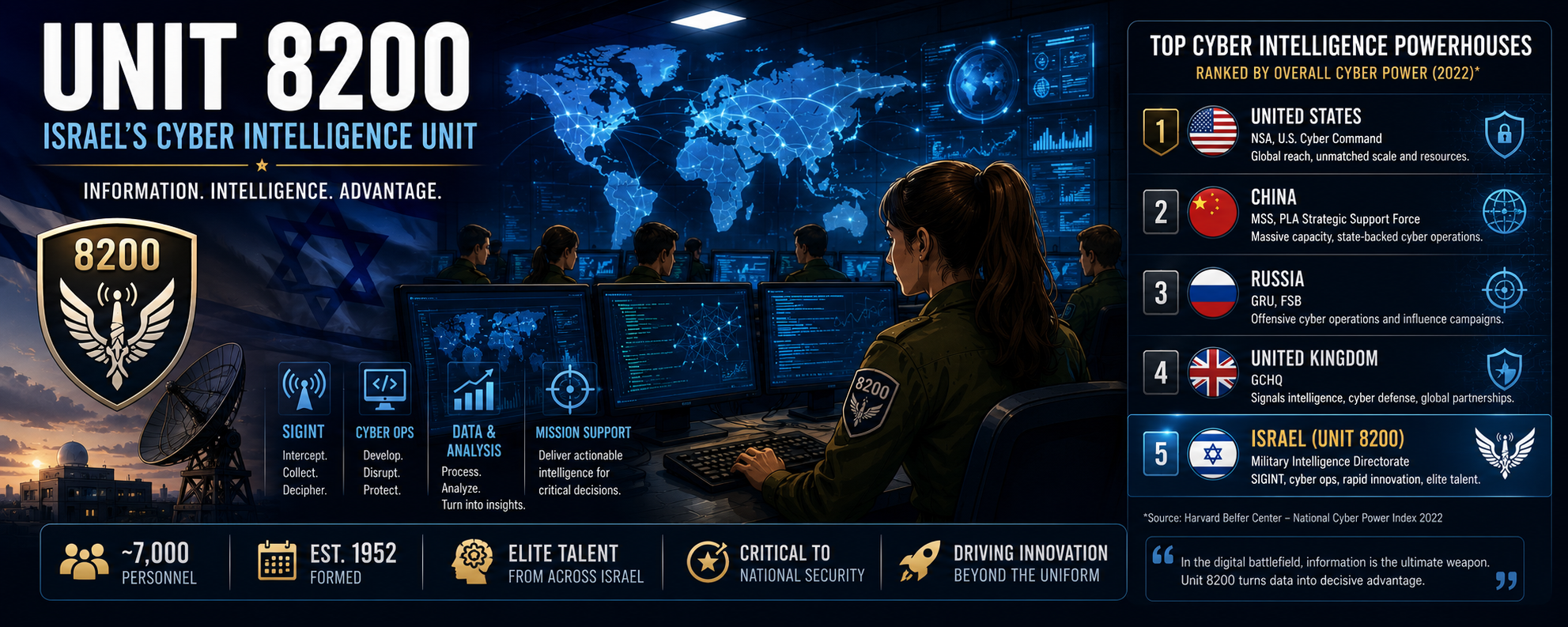
Unit 8200 at a Glance
Unit 8200 is Israel’s largest military-intelligence unit and its primary information-gathering organization within the IDF’s Military Intelligence Directorate. Public descriptions compare it to the U.S. National Security Agency and Britain’s GCHQ because it is associated with signals intelligence, data analysis, codebreaking, technical collection, and cyber-related activity.
A few quick points help put it in context:
- Main mission: Gather, analyze, process, and distribute intelligence.
- Core specialty: Signals intelligence, often shortened to SIGINT.
- Known reputation: Cyber capability, rapid problem-solving, and selective recruiting.
- Publicly reported size: Several thousand people, although exact figures are classified.
- Cyber defense note: The IDF’s C4I and Cyber Defense Directorate officially handles the IDF’s broader cyber-defense responsibilities, so Unit 8200 should not be treated as the entire Israeli cyber ecosystem.
What Does Unit 8200 Actually Do?
The simplest answer is that Unit 8200 helps Israel understand communications, technology, and signals connected to potential threats. Signals intelligence can involve intercepting and analyzing communications, electronic emissions, network activity, and other technical data. The goal is not just to collect raw information, but to turn it into something military and government leaders can use.
That distinction matters because intelligence collection alone is not very useful without interpretation. A huge pile of intercepted messages, device data, radio traffic, or digital records can easily become noise. Analysts need language skills, technical knowledge, cultural awareness, pattern recognition, and the ability to decide what is urgent. The IDF describes Unit 8200 personnel as developing and using collection tools, then analyzing, processing, and sharing the information with relevant officials.
Public reporting also associates the unit with data mining, technological attacks, cyber-related intelligence, and support for military operations. However, the exact methods, tools, targets, and internal structure are mostly classified. That secrecy creates a lot of mythology around Unit 8200, so it is important to separate what is publicly documented from what is only suspected or attributed by journalists and researchers.
What Is SIGINT?
SIGINT stands for signals intelligence. In plain English, it means intelligence gathered from electronic signals and communications rather than from a person physically reporting information.
That can include radio traffic, phone communications, satellite transmissions, network activity, radar signals, or other electronic systems. SIGINT organizations are usually interested in answering practical questions: What is happening? Who is communicating? Is a military unit moving? Is an attack being planned? Is an adversary changing equipment, tactics, or readiness?
This is why Unit 8200 is often compared with the NSA and GCHQ. The NSA describes its core work as foreign signals intelligence and cybersecurity, while GCHQ describes itself as the United Kingdom’s intelligence, security, and cyber agency. Unit 8200 fills a somewhat similar role for Israel, although every country organizes intelligence, military cyber operations, and civilian oversight differently.
Why Is Unit 8200 Considered So Strong?
Unit 8200’s reputation comes less from one secret weapon and more from a system that combines recruiting, training, pressure, technical work, and real operational consequences. Israel’s mandatory military-service system gives intelligence organizations a large pool of young people to assess. Reuters reported that many Unit 8200 personnel are selected in their late teens or early twenties, with some identified through competitive school programs before serving.
The unit is known for bringing together people with different strengths. Some may be strong in programming, cryptography, mathematics, electronics, or networking. Others may specialize in Arabic, Persian, Russian, translation, intelligence analysis, or understanding regional political and military context. An older but detailed Swiss open-source study described selection and training that included technical fields, communications, electrical engineering, language capability, fast learning, and critical thinking.
Another major factor is culture. Former members have often described Unit 8200 as having a startup-like environment, with smaller teams given difficult problems and room to improvise. That does not mean the unit is casual or unstructured—it is still military intelligence—but it suggests that junior people can receive meaningful responsibility earlier than they might in a large traditional corporation.
The Unit 8200 Talent Pipeline
One reason Unit 8200 gets so much attention outside the military is what happens after service. Veterans have gone on to work in cybersecurity, cloud security, artificial intelligence, fintech, venture capital, and Israeli technology companies.
That does not mean every successful Israeli founder came from Unit 8200, and it would be foolish to pretend one military unit created an entire national technology sector. Israel’s startup ecosystem also depends on universities, investors, global partnerships, government policy, entrepreneurship, and private-sector research. Still, Unit 8200 has clearly become an important professional network and training ground for many people entering technology careers.
The practical lesson is bigger than Israel. Technical talent grows faster when people are given difficult real-world problems, strong mentors, fast feedback, and responsibility for outcomes. A student who spends years only memorizing theory may know many concepts. Someone who has to solve a difficult operational problem with a small team, limited time, and real consequences often develops judgment much faster.
Was Unit 8200 Involved in Stuxnet?
Stuxnet is one of the operations most commonly associated with Unit 8200. The malware, discovered publicly in 2010, targeted industrial-control systems and is widely believed to have damaged Iranian uranium-enrichment centrifuges. It became historically important because it showed that cyber operations could cause physical disruption to real-world machinery.
Israel has not publicly provided a complete official account confirming every detail of its role. Reuters and other major reporting have linked Stuxnet to Israel and the United States, while researchers have treated it as an example of state-level cyber sabotage. The responsible wording is that Unit 8200 is widely associated in public reporting with Stuxnet, rather than claiming that every operational detail is settled fact.
The bigger takeaway is that Stuxnet helped change how governments think about cyber power. It showed that software could be used not just to steal information, but to interfere with industrial systems and physical infrastructure. That is part of why organizations like Unit 8200 are studied so closely by cybersecurity professionals, policy experts, and military planners.
Is Unit 8200 the Best Cybersecurity Unit in the World?
There is no honest public ranking that can declare Unit 8200 the undisputed number-one cyber organization in the world.
The problem is simple: the most capable intelligence and cyber units do not publish their best operations, budgets, tools, access methods, failures, or staffing numbers. A country may appear less capable only because its most successful operations were never detected. Another country may look powerful because many incidents were publicly attributed to it, even though that visibility can also reveal operational weaknesses.
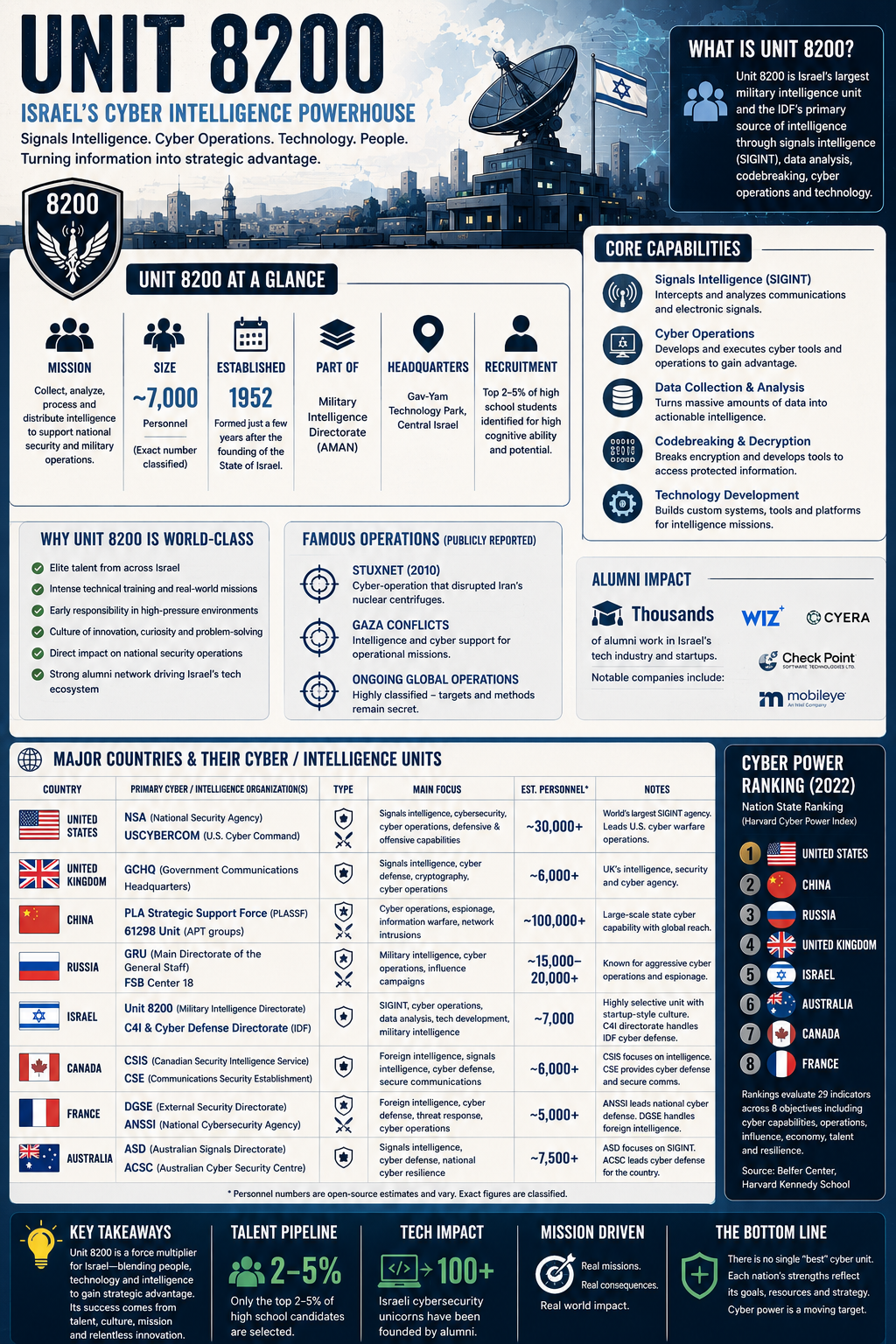
Harvard’s National Cyber Power Index is useful because it openly warns about this problem. Its 2022 assessment measured countries—not individual secret units—using 29 indicators across eight cyber-power objectives. It ranked the United States, China, Russia, and the United Kingdom as the top four most comprehensive cyber powers based on publicly available evidence, while also stating that public data cannot definitively measure the technical sophistication of classified operations.
A more realistic comparison looks like this:
| Organization or Country | Broad Public Reputation |
|---|---|
| United States / NSA | Enormous global scale, signals intelligence, cybersecurity, and military partnerships. |
| United Kingdom / GCHQ | Long-established intelligence and cryptography capability, with major cyber-security responsibilities. |
| China | Large-scale state cyber capability, intelligence collection, industrial capacity, and global reach. |
| Russia | Strong reputation for intelligence operations, intrusion activity, disruptive campaigns, and information warfare. |
| Israel / Unit 8200 | Highly regarded for intelligence integration, technical talent, rapid operational support, and startup-driven cyber expertise. |
Unit 8200 may be among the most respected cyber-intelligence organizations for its size. But the United States, China, Russia, and the United Kingdom have different resources, global missions, legal structures, intelligence alliances, and military objectives. Calling one organization “best” without defining what “best” means is more hype than analysis.
The October 7 Lesson: Intelligence Is Not the Same as Understanding
Even elite intelligence organizations can fail.
Unit 8200 faced major criticism after Hamas’s October 7, 2023 attack on Israel. Reuters reported that the unit’s commander announced his resignation in 2024 after the intelligence failure, which damaged the unit’s reputation along with that of Israel’s wider defense and intelligence establishment.
That does not prove the unit lacks technical skill. It shows something more important: collecting signals and data does not automatically produce correct decisions. Intelligence organizations can be overwhelmed by noise, trapped by assumptions, influenced by organizational culture, or unable to persuade leaders that a threat is urgent.
This is a valuable lesson for civilian cybersecurity too. A company can have logs, alerts, endpoint protection, dashboards, and expensive security software, yet still miss the real threat. Security depends on people asking the right questions, challenging assumptions, and responding before warning signs become a crisis.
The Ethical and Privacy Debate
A serious article about Unit 8200 should not pretend that intelligence capability exists outside ethical questions. Signals intelligence, surveillance, cyber operations, and battlefield targeting can affect privacy, civil liberties, civilian safety, and international law.
Unit 8200 has faced criticism over surveillance practices involving Palestinians. In 2025, Microsoft said it disabled certain services used by an Israeli military unit after preliminary evidence supported reporting about mass surveillance of Palestinian phone calls; the review and surrounding allegations remained politically and legally contentious.
The key point is not to make casual judgments from a distance. It is to recognize that technical ability does not answer moral questions by itself. The more powerful intelligence tools become, the more important oversight, accountability, privacy protections, and clear legal rules become.
What Cybersecurity Professionals Can Learn From Unit 8200
Most cybersecurity teams will never operate like a military-intelligence unit, and they should not try to. But there are useful lessons for IT professionals, small businesses, and aspiring security analysts.
- Build mixed teams. Security needs technical people, but it also needs communicators, analysts, investigators, and people who understand the business.
- Train for judgment, not just certificates. Certifications matter, but real skill comes from labs, troubleshooting, incident analysis, and solving unfamiliar problems.
- Keep feedback loops short. Security teams improve faster when they learn quickly from incidents, near misses, and failed controls.
- Treat intelligence as a starting point. Alerts and threat feeds are useful only when someone can interpret them correctly.
- Do not hero-worship cyber units. Capable organizations still make mistakes, face tradeoffs, and need ethical limits.
The Bottom Line
Unit 8200 is one of the world’s most closely watched military-intelligence organizations because it blends signals intelligence, technical development, cyber capability, data analysis, and battlefield support. Its reputation is reinforced by the number of technology and cybersecurity leaders who have emerged from its alumni network.
But the real story is more interesting than “Israel has the world’s best hackers.” Unit 8200 represents a national model built around selective recruiting, early responsibility, technical specialization, intelligence analysis, and fast operational feedback. It is powerful because it combines people, technology, culture, and mission—not because of one magical hacking tool.
For anyone studying cybersecurity, the biggest lesson is simple: strong cyber capability is not only about writing code or finding vulnerabilities. It is about understanding systems, interpreting information, working with others, questioning assumptions, and making good decisions under pressure.
Related External Links
- IDF Military Intelligence Directorate Overview — Official IDF overview of the Military Intelligence Directorate and Unit 8200’s public role.
- Harvard National Cyber Power Index 2022 — Explains why global cyber-power rankings are useful but cannot fully measure secret technical capabilities.
All of these organizations are incredibly difficult to become a part of. My dream is to work for CSIS but I doubt these certs I’ve been acquiring will even improve my chances. Either university educated or hit the bricks. Which is a shame because with that attitude how many gifted potential employees are heading to the dark web to make a living…