
Inside the Dark Web: Tor, Silk Road and Gnosticplayers
The dark web is frequently described as a hidden Internet populated by hackers, drug dealers and anonymous criminals. That description contains some truth, but it misses the technology, legitimate uses and human mistakes that make its history so interesting. Tor began as a privacy and communications system, not a criminal marketplace, while sites such as The Farmer’s Market and Silk Road demonstrated how anonymity technology could be combined with online commerce. Years later, the name Gnosticplayers became associated with a different underground economy built around stolen databases rather than mailed narcotics.
These stories are related, but not in the way they might initially appear. Gnosticplayers did not create Tor, operate Silk Road or run The Farmer’s Market. Instead, all four subjects represent different parts of an evolving ecosystem: Tor supplied a privacy layer, early marketplaces experimented with hidden e-commerce, Silk Road combined that technology with Bitcoin and Gnosticplayers used later criminal markets to monetize stolen information. Understanding their differences reveals far more about the dark web than treating everything as one mysterious organization.
At a Glance
- Tor is a privacy network that routes connections through multiple relays to obscure a user’s IP address.
- The dark web is a collection of intentionally hidden services that require specialized software or configurations to reach.
- The Farmer’s Market was an early online narcotics marketplace that eventually operated through Tor but used conventional and digital payment services.
- Silk Road launched in 2011 and combined a Tor onion service, Bitcoin payments, escrow and vendor reviews.
- Ross Ulbricht created and operated Silk Road under the name “Dread Pirate Roberts,” was convicted in 2015 and received a full presidential pardon in 2025.
- Gnosticplayers became known in 2019 for offering enormous collections of stolen account data through underground markets.
- Reports of a predominantly French Gnosticplayers organization require qualification: French individuals have been linked to the name, but public attribution remains complicated and partly disputed.
The Surface Web, Deep Web and Dark Web
The surface web consists of pages that conventional search engines can discover and index. Public news sites, accessible company pages and most ordinary blogs belong to this category. It is the visible portion of the Internet, but it is not necessarily the largest portion. Search engines only index content they can reach, interpret and are permitted to include.
The deep web includes online resources that are not publicly indexed, such as email inboxes, banking portals, subscription databases, private cloud storage and company intranets. Most deep-web activity is routine and lawful. Logging into a medical portal does not place someone in a sinister corner of the Internet; it simply retrieves information that a search engine cannot access. “Deep web” and “dark web” therefore should not be treated as interchangeable terms.
The dark web is a smaller, deliberately concealed part of the deep web. Its services are designed to hide their network locations or restrict access through systems such as Tor or I2P. A Tor onion service normally uses an address ending in .onion, which ordinary browsers and the conventional Domain Name System cannot resolve. Some onion services host criminal markets, but others provide anonymous tip lines, censorship-resistant publishing, private communications and safer access to news organizations.
What Is Tor?
Tor is short for “The Onion Router,” although the project now generally uses Tor rather than writing the name as the all-capital acronym “TOR.” Onion routing research began at the United States Naval Research Laboratory during the 1990s. The objective was to separate a user’s identity from the route taken by their Internet traffic, helping protect sensitive communications. The technology eventually developed into the open-source Tor network maintained by the nonprofit Tor Project.
The onion metaphor describes layered encryption. Before transmitting a request, the Tor client establishes a circuit through several independently operated relays and wraps the routing instructions in multiple cryptographic layers. Each relay removes—or “peels away”—only the layer intended for it. A relay consequently knows where it received traffic from and where to send it next, but it is not supposed to know the circuit’s complete path.
How an Ordinary Tor Circuit Works
A typical connection from Tor Browser to a normal Internet website involves three positions:
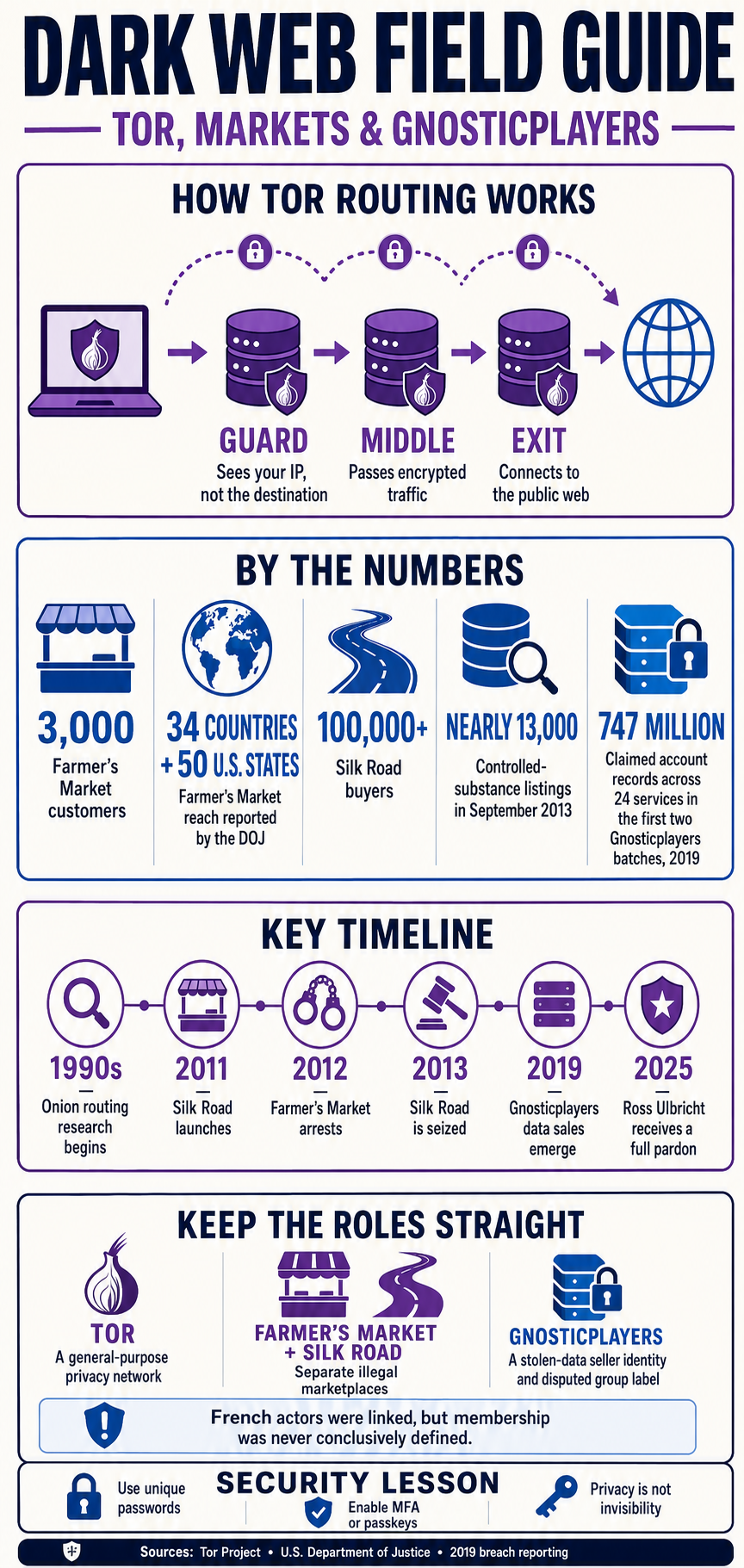
- Guard or entry relay: This relay receives the connection from the user and can see the user’s IP address, but it does not receive the final destination in readable form.
- Middle relay: This passes encrypted traffic between the guard and exit. It knows only the adjacent relays in the circuit.
- Exit relay: This sends the request to the destination website. The website sees the exit relay’s IP address rather than the user’s home address.
Tor distributes knowledge rather than making information disappear. The entry relay knows where the traffic began, while the exit side knows where it is going, but neither should have the complete picture. When a person uses Tor to reach a conventional website, the connection between the exit relay and that website must still be protected with HTTPS. Otherwise, an exit operator could potentially observe or manipulate unencrypted application traffic.
How an Onion Service Is Different
An onion service keeps the destination server inside the Tor network. There is no conventional exit relay connecting the visitor to the public web. Instead, the service establishes protected introduction points, publishes a signed descriptor and meets the client through a rendezvous point. Both sides build Tor circuits, concealing the client’s location from the service and the service’s location from the client.
Modern onion addresses are long because they incorporate cryptographic identity information. The address helps the client authenticate that it has reached the intended service, while the traffic between the browser and onion host remains encrypted. The Tor Project’s onion-service documentation explains that a complete connection can involve six relays—three selected on the client side and three on the service side.
How Do People Enter the Dark Web?
The safest legitimate method is to obtain Tor Browser directly from the official Tor Project. Tor Browser is based on Firefox but incorporates Tor routing, anti-fingerprinting measures, site isolation and privacy-focused defaults. After it connects to the network, it can open ordinary websites through Tor or visit a correctly entered .onion address. Downloading unofficial “dark-web browsers,” mystery software bundles or modified installers is an unnecessary malware risk.
A responsible introductory workflow is straightforward:
- Download Tor Browser only from the official Tor Project website.
- Verify the site and installer rather than trusting advertisements or third-party download pages.
- Use the browser for a legitimate privacy, research or censorship-resistance purpose.
- Obtain onion addresses from the organization operating the service, when possible.
- Avoid random onion directories, unknown downloads and offers involving illegal goods or stolen information.
- Remember that using privacy technology does not make unlawful conduct legal.
Accessing Tor is not the same as becoming anonymous under all circumstances. Logging into a personal account reveals the account holder to that service, even if Tor conceals the connection’s originating IP address. Downloaded documents can contact external resources when opened in another application, malicious scripts can exploit a browser vulnerability and repeated usernames can connect identities across different websites. Tor is a powerful privacy layer, but anonymity depends on the user, browser, operating system, destination, payments and physical-world behaviour working together.
The Farmer’s Market: A Proto–Dark Web Marketplace
The Farmer’s Market is less famous than Silk Road, but it occupies an important position in dark-web history. The marketplace had previously operated under the name Adamflowers and offered independent drug suppliers a digital storefront, order forms, forums, customer service and payment processing. Its operators reportedly screened vendors and guaranteed delivery in return for commissions. In other words, it already contained many features later associated with darknet markets.
The operation did not initially depend entirely on Tor. It evolved across conventional online infrastructure, anonymizers and eventually the Tor network, while payments passed through services including Western Union, PayPal, Pecunix and I-Golder. Those payment methods were a serious weakness because financial intermediaries and transaction records could create investigative trails. Unlike Silk Road, The Farmer’s Market did not build its entire economic system around Bitcoin.
A multinational DEA investigation called Operation Adam Bomb dismantled the operation in April 2012. According to the archived Department of Justice announcement, authorities arrested eight people and alleged that the marketplace supplied approximately 3,000 customers across 34 countries and all 50 U.S. states. The indictment said that between January 2007 and October 2009 alone, two leading defendants processed 5,256 orders valued at approximately US$1.04 million. A later guilty plea acknowledged that the broader operation processed roughly US$2.5 million in orders over several years.
The Farmer’s Market demonstrated that hiding a website’s IP address did not conceal conventional payments, postal deliveries, customer communications or the people operating the business. Its importance lies less in its size than in its transitional design. It connected older online drug distribution with the dedicated Tor marketplaces that followed. For that reason, it is sometimes described as a “proto–Silk Road.”
Silk Road and the Darknet Marketplace Template
Ross William Ulbricht created Silk Road around January 2011. The site operated as a Tor onion service and used Bitcoin as its primary currency, allowing pseudonymous buyers and sellers to conduct transactions without relying on credit cards or traditional merchant accounts. Silk Road also held payments in escrow until a transaction was completed and allowed customers to review vendors. These familiar e-commerce mechanisms attempted to manufacture trust between people who did not know one another and could not rely on courts or conventional consumer protection.
Silk Road prohibited some categories that its operator considered harmful, but illegal drugs dominated its inventory. The marketplace also included forged documents, hacking-related services and other unlawful goods. According to evidence summarized by the Department of Justice, the site had almost 13,000 controlled-substance listings in September 2013. Prosecutors said thousands of vendors supplied more than 100,000 buyers and generated hundreds of millions of dollars in transactions during the site’s operation.
The combination of Tor, Bitcoin, escrow and reputation systems made Silk Road more scalable than earlier experiments. Tor concealed the marketplace’s network location, Bitcoin transferred value without a traditional payment processor, escrow reduced the risk of vendors disappearing with a buyer’s money and reviews allowed reputable sellers to distinguish themselves. None of these technologies was inherently criminal. Their combination, however, created an unusually durable platform for illegal international commerce.
Who Was Ross Ulbricht?
Ulbricht was a Texas-born physics graduate who became interested in libertarian economics and unregulated markets. He operated Silk Road using the pseudonym Dread Pirate Roberts, a reference to the fictional title passed between characters in The Princess Bride. Public writings associated with the account portrayed Silk Road as more than a profit-making enterprise. It was presented as an experiment in voluntary exchange beyond government control.
That philosophy did not change the marketplace’s legal exposure. Authorities arrested Ulbricht at a public library in San Francisco on October 1, 2013, while he was using a laptop linked to Silk Road administration. Investigators could then access active sessions, records and communications that would have been considerably more difficult to obtain from a powered-down, encrypted computer. The site was seized and taken offline at approximately the same time.
A federal jury found Ulbricht guilty on all seven counts in February 2015. The convictions covered narcotics distribution, distribution through the Internet, operating a continuing criminal enterprise, computer-hacking conspiracy, money-laundering conspiracy and false-identification-document trafficking. He was sentenced to two concurrent life terms plus additional concurrent prison terms. Although allegations involving solicited violence appeared in the government’s case and sentencing debate, Ulbricht was not convicted of murder or murder-for-hire in that trial—a distinction frequently lost in simplified retellings.
On January 21, 2025, President Donald Trump granted Ulbricht a full and unconditional pardon after he had spent more than 11 years in custody. The official pardon warrant covered the federal convictions and associated punishment. A pardon removed the remaining federal consequences and enabled his release, but it did not function as a judicial finding that the trial evidence was false or automatically erase the historical conviction.
Why Tor and Bitcoin Did Not Make Silk Road Invisible
Tor can conceal network routes, but it cannot prevent an operator from leaving identifying evidence outside Tor. Investigators connected early advertisements for Silk Road to the username “altoid,” which had also appeared in a post containing an email address associated with Ulbricht. Undercover purchases, marketplace communications, server evidence, cryptocurrency records and the contents of the seized laptop added further links. No single anonymity failure explains the entire investigation.
Bitcoin also turned out to be more traceable than many early users assumed. Bitcoin addresses are pseudonymous, but transactions are written to a public blockchain. An address does not contain a legal name, yet investigators can follow transfers and connect them with exchange records, seized devices or other identified addresses. Once one part of a transaction graph is attributed, older payments can become evidence years after they occurred.
Physical products created another unavoidable exposure. Vendors needed to package drugs, buyers needed to provide delivery locations and postal systems transported the parcels. Investigators could make undercover purchases, inspect packaging, conduct surveillance and identify repeated shipping patterns. Silk Road concealed an online meeting place, but much of its business still touched the physical world.
Gnosticplayers and the Stolen-Database Economy
Gnosticplayers appeared prominently in cybersecurity reporting during 2019, when enormous collections of user records were offered through Dream Market and other underground channels. One early wave reportedly contained approximately 617 million accounts from 16 services, followed by another claimed 127 million records from eight companies. The affected data varied by breach but reportedly included email addresses, usernames, profile details, IP addresses and password hashes. Some of the affected services had already disclosed security incidents, while others learned that purported data from their systems was being advertised.
The value of these databases was not limited to reading somebody’s old profile. Attackers could crack weak password hashes, test reused credentials against other services, construct targeted phishing campaigns or combine several leaks into more complete identity profiles. This is why an old password from an apparently unimportant website can remain dangerous. It can become the first credential tested against email, cloud storage, banking or business accounts.
The name itself caused confusion. Contemporary reporting sometimes described Gnosticplayers as a single Pakistani hacker, based largely on what the person using the identity told journalists. Other researchers later described Gnosticplayers as a group or shared banner containing several participants. Public reporting therefore does not support a simple, permanent membership list.
Was Gnosticplayers Mostly French?
There is a genuine French connection, but “an organization with mostly French members” is stronger than the available evidence supports. In a 2023 case concerning the alleged ShinyHunters hacking group, the U.S. Department of Justice identified French citizen Gabriel Kimiaie-Asadi Bildstein using aliases that included “Kuroi” and “Gnostic Players.” The same indictment named two other French citizens and described an alleged conspiracy involving phishing, stolen corporate information, data sales and extortion. The DOJ emphasized that the charges were allegations unless proven in court.
Private cybercrime researchers have argued that Gnosticplayers, NSFW and ShinyHunters involved overlapping participants or represented successive versions of the same network. Those assessments may explain why French names are prominent in later accounts. However, they do not conclusively prove that every intrusion or database sold under the Gnosticplayers name was performed by one stable French organization. Underground identities can be shared, imitated, transferred or deliberately misrepresented.
The most accurate description is therefore that Gnosticplayers began publicly as a seller or persona and was later associated with a broader cluster of data thieves, including alleged French actors. The label did not necessarily operate like a conventional hacking club with a headquarters, formal membership and consistent chain of command. It was part brand, part marketplace identity and possibly part collaborative network.
How These Stories Are Actually Connected
The relationship becomes clearer when placed in chronological order:
- 1990s–2000s: Onion routing and Tor develop as general-purpose privacy technologies.
- 2006–2012: Adamflowers and The Farmer’s Market experiment with online drug sales, anonymizers, Tor and multiple payment systems.
- 2011–2013: Silk Road combines a Tor onion service, Bitcoin, escrow and seller reputation into the defining darknet-market model.
- 2013–2015: Silk Road is seized, Ulbricht is prosecuted and successor markets attempt to reproduce the model.
- 2019 onward: Gnosticplayers and other data sellers use underground markets to distribute databases and credentials at enormous scale.
- 2025: Ulbricht receives a full presidential pardon, renewing debate over Silk Road, digital privacy, sentencing and online intermediary responsibility.
The connecting thread is not a secret organization. It is the gradual construction of an underground commercial infrastructure. Tor supplied location privacy, cryptocurrency provided pseudonymous value transfer, marketplaces created trust mechanisms and stolen-data brokers supplied a new category of digital merchandise. Each layer solved one problem while introducing evidence, dependencies and vulnerabilities of its own.
The Technical Lesson: Anonymity Is a System, Not a Switch
The largest misconception surrounding the dark web is that opening Tor Browser places someone behind an impenetrable wall. Tor primarily protects network-location information. It cannot correct a reused username, an identifiable writing style, a personal email address, a compromised device or a cryptocurrency withdrawal tied to a regulated exchange. Nor can it hide a package once that package enters a postal network.
Marketplace operators face even greater exposure because they must remain online, communicate repeatedly and maintain infrastructure over long periods. Every administrative login, software update, support message and financial transfer becomes another opportunity for correlation. A system can be cryptographically sound while the person operating it makes ordinary human mistakes. Silk Road and The Farmer’s Market both illustrate that divide.
The Gnosticplayers story adds a different lesson: breached data persists. Once a database has been copied and sold, changing the original website or taking down a market does not retrieve every copy. Collections can be repackaged, combined and traded years later. Dark-web enforcement can disrupt distribution, but organizations must prevent the initial theft and users must limit the value of any credentials that escape.
Practical Security Lessons for Ordinary Users
The history leads to several practical defensive measures:
- Use a password manager to generate a unique password for every important account.
- Enable phishing-resistant multifactor authentication, preferably passkeys or hardware security keys, when available.
- Treat email accounts as high-value assets because password resets for other services often pass through them.
- Replace compromised passwords everywhere they were reused, not only on the breached website.
- Be suspicious of messages that use accurate personal information to create urgency or credibility.
- Keep browsers, operating systems and document readers patched against known vulnerabilities.
- Check reputable breach-notification services and respond promptly to confirmed exposure.
- Do not assume that Bitcoin, Tor, a VPN or private-browsing mode provides complete anonymity.
For website operators, the corresponding lesson is to minimize stored personal data, restrict database exposure, patch Internet-facing services and use modern password hashing such as Argon2id or an appropriately configured bcrypt implementation. Centralized collections of user information attract attackers because one successful intrusion can produce millions of saleable records. Logging and monitoring should also be designed to detect abnormal database queries, mass exports and suspicious privileged access before an entire dataset leaves the environment.
Conclusion
Tor, The Farmer’s Market, Silk Road and Gnosticplayers belong to the same broad history, but they played very different roles. Tor is a privacy network with lawful and socially valuable uses. The Farmer’s Market was an early online narcotics operation that exposed the weaknesses of conventional payments and physical delivery. Silk Road then combined Tor, Bitcoin and e-commerce design into a model that transformed underground markets.
Gnosticplayers represents a later stage in which the merchandise itself could be entirely digital: databases, credentials and personal information stolen from mainstream services. The reported French connection is real enough to discuss, particularly through later allegations involving ShinyHunters, but the public evidence does not justify presenting Gnosticplayers as a clearly defined, predominantly French club. Its uncertain identity is itself part of the lesson.
The dark web does not eliminate evidence or human error. It redistributes trust, obscures selected pieces of network information and forces investigators to connect technical, financial and physical clues. That makes Tor powerful, darknet markets dangerous and perfect anonymity far more difficult than popular mythology suggests.
- Tor Project: How Onion Services Work — Learn how introduction points, descriptors, rendezvous points and Tor circuits protect onion-service locations.
- U.S. Department of Justice: Ross Ulbricht Trial Summary — Review the official case summary, charges and evidence presented against the Silk Road operator.
These links look interesting. I remember hearing of silk road, in 2013. Also this was the era when you could buy chemicals from Chinese labs that were slightly different in their molecular makeup from popular street drugs and have them shipped to your house. I remember “meow meow” lol