
Stuxnet Explained: The Malware That Damaged Machines
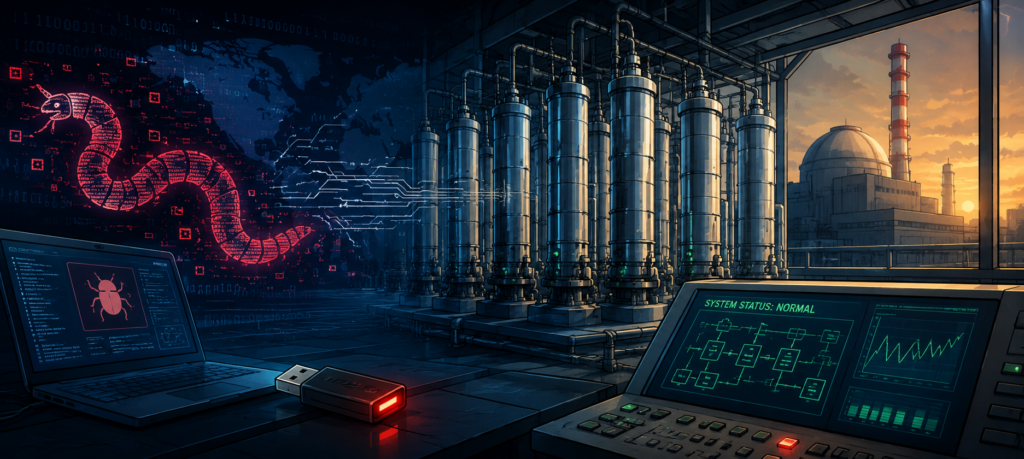
Most malware is built to steal something, lock something, spy on someone, or cause digital chaos. Stuxnet was different. It was designed to quietly interfere with real-world industrial equipment—and it helped prove that a computer worm could cross the line from damaging files to damaging physical machines.
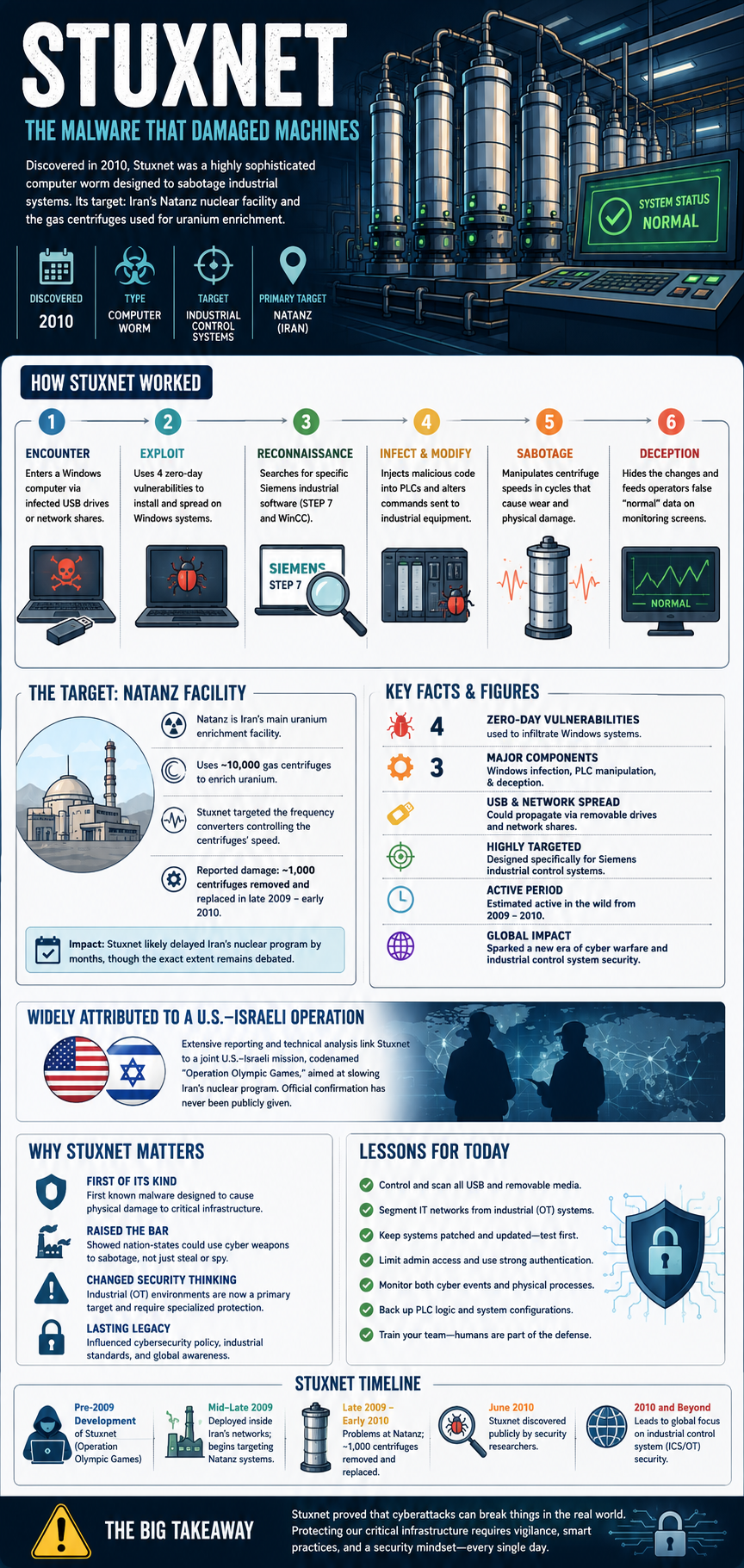
Discovered publicly in 2010, Stuxnet became one of the most famous cyberattacks in history because of its target: industrial control systems connected to Iran’s uranium-enrichment program. It did not simply crash computers or erase data. It infiltrated Windows machines, searched for very specific Siemens industrial software, altered commands sent to physical equipment, and attempted to hide the sabotage from the people watching the systems.
The result was a turning point in cybersecurity. Stuxnet showed governments, utilities, factories, water-treatment plants, and security professionals that cyberattacks could have consequences far beyond a computer screen.
Stuxnet at a Glance
Stuxnet was a highly sophisticated computer worm that targeted industrial control systems rather than ordinary office computers. It was built to find specific Siemens STEP 7 and WinCC environments used to monitor and control industrial processes.
Its most widely reported target was Iran’s Natanz uranium-enrichment facility, where gas centrifuges were used to enrich uranium. A centrifuge is a fast-spinning machine that separates isotopes in uranium gas; it must operate within very precise conditions to avoid damage.
Stuxnet is widely attributed in public reporting and analysis to a U.S.–Israeli operation, often associated with the code name Operation Olympic Games. The technical evidence shows an exceptionally well-funded and carefully targeted attack, but the exact operational details and full chain of command have never been publicly confirmed in one complete official account.
What Was Stuxnet?
Stuxnet was a worm, meaning it could spread from one computer to another without depending entirely on a person manually sending an infected file. But calling it “just a worm” misses the point. The Windows infection and spread mechanisms were only the opening act.
The real mission was to reach programmable logic controllers, usually called PLCs. A PLC is a rugged industrial computer that tells physical equipment what to do. In a factory, a PLC may control conveyor belts, pumps, motors, valves, robotic arms, temperature systems, or other machinery. In a uranium-enrichment facility, it can help control the equipment that keeps centrifuges operating within narrow tolerances.
That is why Stuxnet mattered so much. It did not merely compromise a computer network. It tried to manipulate the physical process controlled by that network.
The Target: Iran’s Centrifuges at Natanz
The popular version of the story is that Stuxnet made Iran’s machines spin “faster and faster until they broke.” That is not completely wrong, but it is too simple.
The target was believed to be gas centrifuges at the Natanz enrichment facility in Iran. These machines use extremely high-speed rotating components to separate uranium isotopes. They are delicate, expensive, and highly sensitive to changes in speed, pressure, vibration, and other operating conditions.
Stuxnet was designed to interfere with the frequency converters that helped regulate the centrifuges’ rotational speed. Instead of leaving the machines at a stable operating speed, the malware could alter the commands sent to the equipment in carefully timed cycles. Researchers found that its payload was aimed at frequency drives operating within a very specific range, showing that this was not generic malware sprayed at random industrial systems.
The goal was not necessarily one dramatic explosion. A more effective strategy was to create intermittent, confusing failures that looked like mechanical problems, operator mistakes, or ordinary equipment breakdowns. That could slow operations, create mistrust, and force technicians to replace damaged machines without immediately realizing they were under cyberattack.
How Did Stuxnet Get Into an Isolated Facility?
One reason Stuxnet shocked the world was that industrial facilities are often assumed to be protected by “air gaps.” An air-gapped system is isolated from the public internet and, in theory, cannot be reached remotely like a normal office computer.
The problem is that air gaps are rarely perfect.
Industrial facilities still need contractors, engineers, software updates, maintenance laptops, USB drives, backup systems, and replacement equipment. Every one of those things can become a bridge between an outside network and a supposedly isolated control environment.
Stuxnet could spread through infected USB drives and network shares. It also exploited multiple Windows vulnerabilities to move between systems. ENISA’s analysis noted that the malware used USB devices and network shares for propagation, while targeting Siemens industrial-control environments.
The exact initial entry route into Natanz has never been publicly proven in full detail. That matters because it is easy to turn the story into a Hollywood-style claim about one employee plugging in one infected USB stick. The reality is more likely that the attack involved multiple stages, extensive reconnaissance, and a deep understanding of the target’s equipment and engineering workflow.
How Stuxnet Worked: Three Layers of the Attack
Stuxnet was dangerous because it combined several different kinds of cyberattack into one operation.
1. It Infected Windows Computers
The first layer targeted regular Windows systems. Stuxnet used several zero-day vulnerabilities—security flaws not yet publicly known or patched at the time—to infect and spread through computers.
CISA’s advisory noted that Stuxnet used four zero-day exploits, an unusually large and expensive collection for one malware campaign.
That alone made it remarkable. Most criminal malware uses cheap, repeatable methods. Stuxnet used rare vulnerabilities that suggested serious funding, technical expertise, and a high-value target.
2. It Looked for Specific Engineering Software
Once inside a network, Stuxnet was not interested in every computer. It searched for systems running Siemens STEP 7 software and related industrial-control technology.
STEP 7 is engineering software used to configure and program Siemens PLCs. Think of it as part programming tool, part control console, and part bridge between an engineer’s computer and the machinery on the factory floor.
Stuxnet could wait quietly until it found the exact kind of industrial environment it wanted. This made it far more selective than ordinary malware. Most infected computers were not the intended target; they were simply stepping stones.
3. It Altered PLC Commands While Hiding the Changes
The final layer was the most alarming. Once Stuxnet reached the right industrial control environment, it could interfere with PLC logic and the commands sent to equipment.
In plain language, it attempted to tell the machinery to behave differently than the engineers intended. At the same time, it used rootkit-style techniques to conceal modified components and make it harder for operators to see what had changed.
That deception element is what made Stuxnet so dangerous. A machine can fail for many reasons: worn parts, overheating, vibration, bad calibration, power issues, or human error. When the monitoring screens appear normal, technicians may spend months chasing mechanical explanations instead of looking for malicious software.
Did Stuxnet Really Damage Iran’s Nuclear Program?
The honest answer is that it appears to have caused real disruption, but the exact scale remains debated.
Reports tied Stuxnet to problems at Natanz between late 2009 and early 2010, when Iran reportedly removed and replaced roughly 1,000 centrifuges. Analysts differ on how much of that disruption can be attributed directly to Stuxnet and how much may have involved existing technical problems or other causes.
Some assessments argue that Stuxnet delayed Iran’s enrichment efforts by months or longer. Others point out that Iran recovered, continued operating centrifuges, and eventually expanded parts of its enrichment capability. Even a Stanford discussion of the incident noted that the attack’s overall effectiveness remains a subject of debate.
So the responsible conclusion is not that Stuxnet “destroyed Iran’s entire nuclear program.” It did not. The stronger and more accurate point is that it demonstrated a cyberattack could quietly disrupt an industrial process and cause physical damage to sensitive equipment.
That is already a massive historical milestone.
Who Created Stuxnet?
Stuxnet is commonly described as a joint U.S.–Israeli cyber operation. Major reporting, security researchers, and policy analysts have connected it to Operation Olympic Games, a covert campaign aimed at slowing Iran’s uranium-enrichment program.
However, this is an area where careful wording matters.
Cybersecurity researchers can analyze code, attack techniques, target choices, and technical sophistication. They can identify clues suggesting state-level resources. But malware does not come with a signed confession attached to it.
Why Stuxnet Changed Cybersecurity Forever
Before Stuxnet, governments and security experts already knew that industrial systems could be vulnerable. But Stuxnet made the danger impossible to ignore.
It showed that cyberattacks could be designed to affect:
- Manufacturing equipment
- Power systems
- Water-treatment facilities
- Transportation networks
- Oil and gas infrastructure
- Medical systems
- Building automation
- Military and defense equipment
The attack also demonstrated that modern cyber threats do not need to be loud. A ransomware attack announces itself immediately because criminals want payment. A sabotage operation may do the opposite: hide, wait, create small failures, and make the victim doubt their own equipment.
Stuxnet also changed the way people think about critical infrastructure. A spreadsheet server and a centrifuge-control network may both use computers, but they are not the same type of security problem. A compromised office computer might expose data. A compromised industrial control system could interrupt electricity, contaminate water, damage machinery, or put workers at risk.
What Businesses Can Learn From Stuxnet Today
Most small businesses do not operate uranium centrifuges. But the lessons from Stuxnet still matter for shops, warehouses, manufacturers, municipalities, farms, and companies that use connected machinery.
Modern operational technology, often called OT, includes the computers and devices that monitor or control physical processes. NIST recommends security practices tailored to OT environments because they have unique reliability, safety, and performance requirements.
Here are the most useful lessons:
- Do not treat USB drives casually.
Removable media can carry malware across isolated systems. Use approved drives only, scan them before use, and restrict who can plug devices into critical computers. - Separate office IT from industrial controls.
A company network should not give every office computer direct access to machines, PLCs, or engineering workstations. Segmentation, firewalls, and restricted access pathways reduce the damage one compromised device can cause. - Patch carefully, but consistently.
Industrial systems cannot always be patched as quickly as office PCs because downtime can be expensive or dangerous. That does not mean ignoring patches. It means testing them properly and applying them through a controlled process. - Limit administrator access.
Not everyone needs the ability to change machine settings or PLC logic. Use role-based access, strong authentication, and separate accounts for routine work versus engineering changes. - Monitor for abnormal physical behaviour.
Security monitoring should not only watch for suspicious logins or malware alerts. It should also detect unusual machine speeds, pressure changes, unexpected valve activity, or commands outside normal operating ranges. - Back up PLC logic and engineering configurations.
A business should know what “good” configuration looks like. Secure, tested backups of controller logic and system settings make recovery faster and help investigators identify unauthorized changes.
Could a Stuxnet-Style Attack Happen Again?
Yes—but it would probably look different.
The original Stuxnet was highly specialized. It was built for a narrow target and depended on detailed knowledge of particular Siemens systems and equipment configurations. That level of precision is difficult and expensive.
But the central idea is now well understood: compromise the computers that control physical systems, change commands at the right moment, and hide the evidence.
That means the danger is no longer limited to nuclear facilities. A modern version could target factories, shipping systems, water utilities, energy infrastructure, smart buildings, or connected agricultural equipment. The biggest risk is often not a dramatic movie-style catastrophe. It is downtime, damaged equipment, unsafe conditions, lost production, and confusion during recovery.
The Lasting Legacy of Stuxnet
Stuxnet remains one of the most important cyber incidents ever discovered because it changed the definition of what malware could do.
It proved that a digital attack could cause physical consequences. It showed that air-gapped environments were not automatically safe. It forced industrial organizations to take PLCs, engineering workstations, removable media, and operational technology security far more seriously.
Most of all, Stuxnet revealed that the line between cybersecurity and physical security had become blurry. A computer worm was no longer just something that could steal your files or slow down your laptop. Under the right conditions, it could quietly reach into the real world and make machines behave in ways their operators never intended.
That is why Stuxnet is still worth studying more than a decade later.
Related External Links
- CISA Stuxnet Advisory — A government advisory covering Stuxnet’s vulnerabilities, affected systems, and mitigation guidance.
- Symantec W32.Stuxnet Dossier — A detailed technical breakdown of Stuxnet’s architecture, propagation methods, and industrial payload.
Definitely not the first time a USB stick cause a tremendous amount of damage. If you ever find a USB laying on the ground or wherever do not ever just plug it in and play. Assume every USB has a payload waiting. Trust me I know from prior experience 😢….