
Finance, Healthcare, Robotics, and the Rise of Real-World AI
For the first few years of the modern AI boom, most people experienced artificial intelligence through a rectangle. You opened a chatbot, typed a question, received an answer, copied the answer somewhere else, and decided whether it was useful. Even when the technology was impressive, it still felt trapped inside the browser tab. It could write, summarize, brainstorm, code, and generate images, but it usually remained separated from money, medicine, mobility, machines, and the physical decisions that shape daily life.
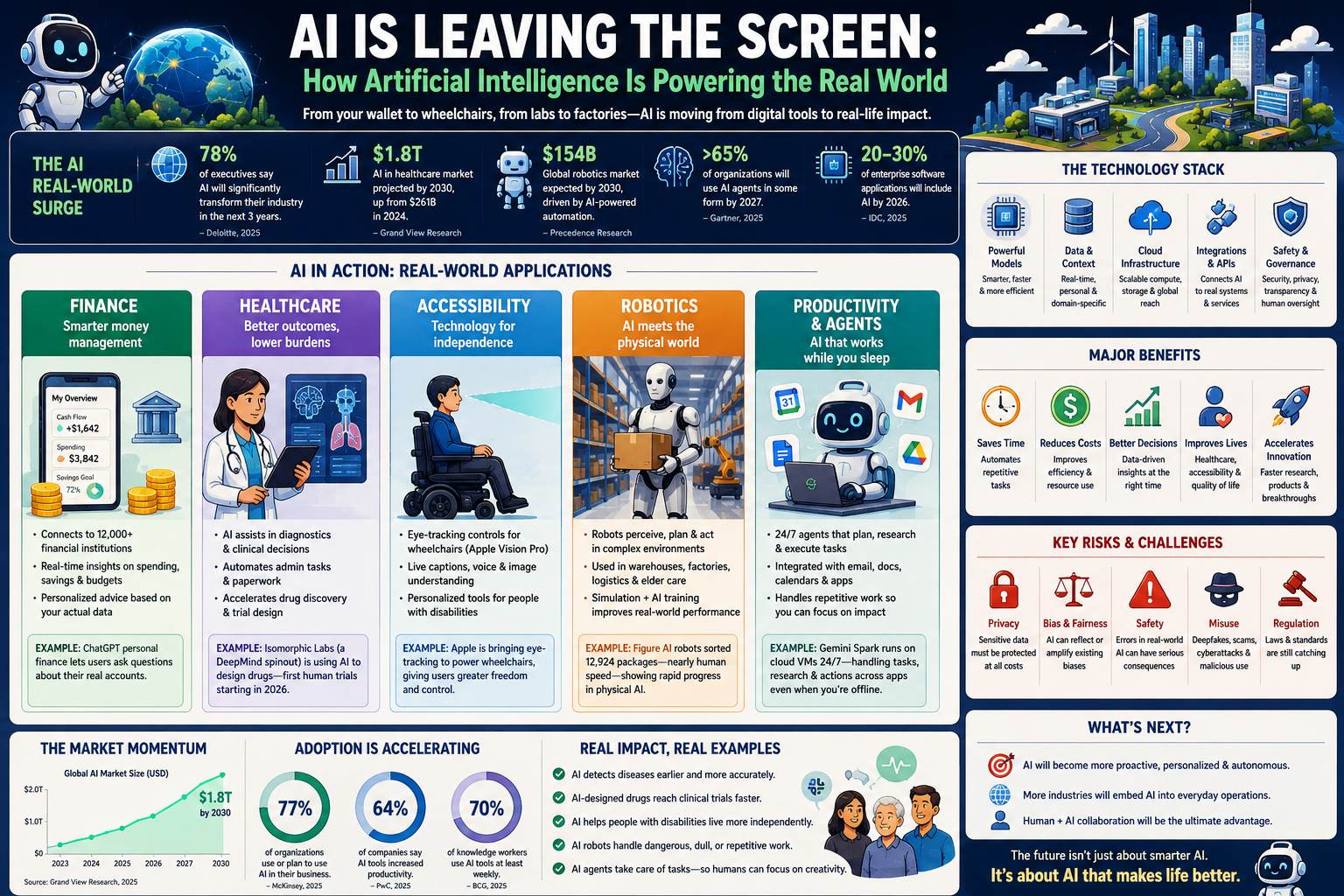
That boundary is starting to break. The newest wave of AI news is not only about smarter models or better benchmarks. It is about AI connecting to bank accounts, helping design cancer drugs, steering accessibility devices, controlling robots, generating personalized media, monitoring health workflows, and becoming a layer between human intent and real-world action. The uploaded newsletter batch kept circling this same pattern: ChatGPT connecting to personal finance data, Isomorphic Labs pushing AI-designed drugs toward human trials, Apple using Vision Pro eye tracking for power wheelchair control, robotics companies showing humanoids in industrial work, and Google positioning background agents as systems that can work while users sleep.
This is a different phase of AI. The first phase was informational: answer my question. The second phase was creative: write, design, generate, edit. The third phase is operational: connect to real systems and help people make or execute decisions. That is where AI gets both more useful and more dangerous. Once AI touches finances, health, physical movement, business operations, or machines, the stakes become higher than whether a paragraph sounds good.
What Is Real-World AI?
Real-world AI is artificial intelligence that moves beyond isolated text generation and becomes embedded inside practical systems, services, devices, and workflows. It is AI connected to live financial accounts, clinical data, robots, vehicles, cameras, sensors, medical research pipelines, accessibility tools, industrial processes, and personal productivity systems. The key shift is that the AI is no longer merely describing the world. It is being connected to systems that can affect the world.
This does not mean every AI tool is suddenly autonomous or safe to trust blindly. Most real-world AI still requires human approval, regulated workflows, controlled access, and careful oversight. But the direction is clear. Instead of asking AI for generic budgeting advice, users can now connect financial accounts and ask questions based on their real transactions. Instead of using AI only to summarize medical articles, drug discovery companies are using AI systems to design molecules. Instead of treating robotics as a pre-programmed automation problem, companies are training models that can perceive, adapt, and act in messy physical environments.
OpenAI’s new personal finance experience is a clean example. OpenAI says Pro users in the U.S. can now connect financial accounts in ChatGPT on web and iOS, with support for more than 12,000 financial institutions, and use that context to ask financial questions grounded in their actual accounts. Plaid, which powers the integration, describes the feature as giving users real-time answers and insights tailored to their actual financial picture rather than generic best practices.
That is the practical difference. A generic chatbot can say, “Make a budget.” A connected finance assistant can say, “Here are the subscriptions you forgot about, here is where your cash flow is leaking, here is what changed this month, and here is a realistic savings target based on your actual behavior.” That is not just information. That is applied intelligence.
Why This Fascinates People
People are fascinated by real-world AI because it makes the technology feel less like a demo and more like infrastructure. A chatbot that writes poems is impressive, but it does not necessarily change your life. An AI that helps a person with ALS steer a wheelchair, helps a researcher design a drug candidate, helps a clinic process paperwork, or helps a household understand cash flow lands differently. It crosses from novelty into utility.
This is also why the emotional reaction to AI is so mixed. On one side, real-world AI is exciting because it could reduce friction in areas that badly need help. Healthcare is overloaded with administration. Personal finance tools are often fragmented and confusing. Robotics could assist in warehouses, manufacturing, elder care, agriculture, and hazardous environments. Accessibility features can give people more independence. Drug discovery is slow, expensive, and failure-heavy.
On the other side, the same movement creates obvious anxiety. If AI connects to your bank account, what happens to privacy and liability? If AI helps design drugs, how do we validate safety? If robots become more capable, what happens to jobs and workplace safety? If AI agents act on our behalf, who is responsible when they make a bad decision? The fascination comes from that tension. Real-world AI is not just cool. It is consequential.
For tech enthusiasts, this is the part worth paying attention to. The next major AI winners may not be the companies with the most entertaining chatbot personalities. They may be the companies that integrate AI into workflows where the value is measurable: time saved, errors reduced, patients helped, costs lowered, tasks completed, or physical work performed.
Finance: AI Gets Closer to Your Wallet
Personal finance has always been one of the most obvious AI use cases. Most people do not need more dashboards. They need interpretation. They need someone, or something, to look across accounts, income, bills, spending, debt, investments, taxes, subscriptions, and goals, then turn that mess into a decision they can understand. The problem is that financial data is sensitive, regulated, and deeply personal.
That is why ChatGPT’s personal finance move matters. OpenAI’s announcement says the feature begins with U.S. Pro users and will expand after early learning, with financial account connections available through more than 12,000 institutions. That turns ChatGPT from a general financial explainer into a context-aware assistant. It can potentially help users analyze spending patterns, understand portfolio changes, identify recurring charges, or think through financial planning questions based on real account data.
This is powerful because financial advice has long been split between expensive human advisors, clunky banking apps, spreadsheet hobbyists, and generic online content. AI could create a middle layer: not a full fiduciary advisor, not a bank, not an investment manager, but an intelligent financial interface that helps people understand what is happening. For millions of users, that may be more useful than another budgeting app.
But the skeptical view is serious. Financial context is not casual data. It includes income, debt, savings, spending habits, family patterns, health-related expenses, locations, subscriptions, investments, and sometimes embarrassing personal details. A finance AI must be secure, explainable, permissioned, and careful. It should not make trades, move money, or push risky recommendations without clear rules and human control.
The bigger business implication is that banks may lose part of the customer relationship if AI assistants become the preferred interface for understanding money. Users may still hold accounts at banks, but they may ask AI to interpret the accounts. That is a major shift. In the same way search engines mediated the web, AI assistants could begin mediating personal finance.
Healthcare: From Diagnosis Support to Drug Discovery
Healthcare is where real-world AI becomes both inspiring and uncomfortable. The upside is enormous. Healthcare systems are overloaded, expensive, fragmented, and full of repetitive administrative work. Patients struggle to understand medical information. Doctors and nurses drown in documentation. Drug development takes years and often fails. Chronic disease management requires constant support that most systems cannot provide at human scale.
The newsletter material included a strong healthcare opportunity map: localized patient education, clinical admin for small practices, plain-language medical information, and chronic disease management tools for conditions like diabetes, hypertension, and asthma. That is exactly where practical AI may create huge value. Not every healthcare AI opportunity needs to be a Nobel-level drug discovery project. Some of the best opportunities are narrow, local, and boring: reminders, intake forms, follow-ups, summaries, triage support, appointment scheduling, insurance paperwork, and patient education.
Then there is the deeper scientific layer. Isomorphic Labs, a Google DeepMind spinoff, has raised major funding to scale AI-driven drug discovery. Reuters reported that the company raised $2.1 billion in a round led by Thrive Capital, with participation from Alphabet-linked investors and others, and that it is targeting first clinical trials by the end of 2026. Isomorphic’s own site frames its mission as using frontier AI to unlock deeper scientific insights and life-changing medicines, building on and beyond AlphaFold.
The significance is not that AI has suddenly cured cancer. It has not. Biology remains brutally complex, and most drug candidates still fail. The significance is that the pipeline from AI-designed molecules to human testing is becoming real. That moves AI drug discovery from theory to clinical validation, where the hard truth of human biology gets a vote.
AI can screen possibilities, predict structures, model interactions, and reduce some wasted effort. But clinical trials exist for a reason. A molecule that looks promising in a model still has to prove safety, dosage, efficacy, side effects, and real-world benefit. AI may accelerate discovery, but it does not repeal biology.
Accessibility: AI as Independence Technology
One of the most meaningful real-world AI stories is accessibility. It does not always get the same hype as coding agents or video generation, but it may be where AI creates some of its clearest human value. Accessibility technology turns intelligence into independence. It helps people read, navigate, communicate, move, and participate more fully in daily life.
Apple’s 2026 accessibility announcement is a strong example. Apple says new features are coming later this year across iPhone, Mac, Apple Watch, and Vision Pro, including Apple Intelligence-powered updates and power wheelchair control using Apple Vision Pro’s eye-tracking system. Apple’s Canadian newsroom notes that the power wheelchair control feature uses Vision Pro’s eye tracking to provide a responsive input method for compatible alternative drive systems, and includes a quote from Pat Dolan, an ALS patient and GeoALS founder, calling independent wheelchair control “gold.”
That is not a minor feature. Eye tracking has usually been discussed in Vision Pro as a user interface breakthrough for spatial computing. Applying that same technology to wheelchair control shows how consumer-grade sensing and AI-adjacent interfaces can spill into assistive technology. The important part is not the headset itself. The important part is the input method: gaze becomes control.
This points to a larger future where accessibility features are not afterthoughts. They become part of mainstream AI and device design. Voice interfaces, image descriptions, real-time captions, natural language navigation, object recognition, and adaptive controls can help people with disabilities, but they also improve usability for everyone. The best accessibility technologies often become general technologies later.
The skeptical concern is affordability and ecosystem dependency. If the most advanced accessibility tools require expensive devices, proprietary systems, or compatible hardware partners, access remains uneven. Still, the direction is encouraging. AI can make assistive technology more adaptive, personalized, and context-aware than older rigid systems.
Robotics: AI Meets the Physical World
Robotics is the most visually dramatic version of real-world AI because it turns software into movement. A chatbot can be wrong in a sentence. A robot can be wrong while carrying a box, crossing a room, operating near people, or handling equipment. That raises the stakes dramatically, but it also makes robotics one of the clearest tests of whether AI can handle reality.
The recent Figure AI package-sorting demos show both the promise and the caution. Business Insider reported that Figure AI held a package-sorting competition between a humanoid robot and an intern, with the intern ultimately winning by 192 packages after sorting 12,924 items. The robot averaged 2.83 seconds per item compared with the intern’s 2.79 seconds, while experts still pointed to practical limitations such as accuracy and package-handling errors.
That is a useful reality check. The robot did not make humans obsolete overnight. But it also did not look like a toy. A humanoid sorting packages at near-human speed, even imperfectly, is a serious milestone. The correct takeaway is not “robots are useless” or “robots are about to replace everyone tomorrow.” The correct takeaway is that physical AI is crossing from lab demo into early operational experiments.
The newsletter material also covered robotics stories involving humanoid livestreams, Unitree’s humanoid ecosystem, medical research labs using robots, robot wolves in Japan, and low-cost student-built robots trained in simulation. Taken together, the pattern is clear: robotics is being pulled forward by better AI models, cheaper sensors, stronger simulation, improved batteries, and more capable control systems.
The bottleneck is still the physical world. Real environments are messy. Objects vary. Floors are uneven. People behave unpredictably. Lighting changes. Sensors fail. Hardware wears out. Maintenance matters. That is why robotics adoption often moves slower than software hype. But once robots can perform a task reliably enough, the economics can shift fast.
World Models and Simulation: Training AI Before Reality
One of the most important behind-the-scenes developments is the rise of world models and simulation systems. These are AI systems designed to understand or generate interactive environments, predict physical dynamics, or create training worlds where agents and robots can learn before being deployed in real settings. This matters because real-world AI needs practice, and practicing in reality is expensive, slow, and sometimes dangerous.
Robots cannot learn every behavior by trial and error in warehouses or homes. Autonomous systems cannot crash repeatedly in the real world while improving. Medical tools cannot experiment casually on patients. Simulation gives AI systems a safer training ground. The better the simulation, the more realistic the training.
The newsletter batch mentioned world models from companies like Odyssey and Nvidia’s open-source SANA-WM, as well as real-time simulation systems used for gaming, robotics training, and physical AI. Even if individual demos vary in maturity, the direction is important. AI is not only generating media for entertainment. It is generating controllable environments that can train future agents, robots, and decision systems.
This is where the line between gaming, robotics, architecture, simulation, and AI training begins to blur. A world model that can generate a realistic room, object motion, sound, lighting, and agent interaction may become useful for robotics training. A model that can simulate weather, traffic, or industrial equipment may help planning systems. The virtual world becomes a rehearsal space for the physical one.
Why Supporters Think This Changes Everything
Supporters of real-world AI argue that this is the moment the technology becomes economically unavoidable. Writing emails faster is useful, but not transformational by itself. AI that reduces clinical paperwork, assists with chronic disease management, designs drug candidates, helps disabled users move independently, monitors financial health, or performs physical work has a clearer value story.
They also argue that AI becomes more powerful when it is connected to context. A generic model can provide general advice. A connected model can work with account data, medical history, sensor readings, calendars, documents, maps, codebases, images, or physical environments. Context turns AI from a clever speaker into a useful operator.
The strongest supporter argument is that many real-world systems are already stretched. Healthcare workers are overloaded. Consumers are financially confused. Supply chains need automation. Aging populations need assistive technologies. Small businesses need better tools. Scientific discovery is expensive. If AI can reduce bottlenecks in these systems, even imperfectly, the payoff is enormous.
This is also where small builders and niche companies may find opportunity. The uploaded content made this point clearly in the healthcare section: the most practical opportunities may be local, specific, and underserved, such as patient education in a particular language, clinical admin for small practices, or chronic disease support for a specific population. That insight applies beyond healthcare. Real-world AI rewards people who understand a painful workflow deeply.
The Skeptical View: Real-World AI Has Real-World Failure Modes
The skeptical view is that real-world AI is much harder than chatbot AI because mistakes matter more. If a chatbot gives a weak movie recommendation, the cost is low. If a finance assistant misunderstands cash flow, a patient education tool oversimplifies a symptom, or a robot mishandles a package near a worker, the cost is higher. The closer AI gets to real systems, the more reliability matters.
Privacy is another major concern. Finance and health data are among the most sensitive forms of personal information. Users may like personalized AI assistance, but they also need clear data controls, deletion policies, security guarantees, and limits on secondary use. Trust will become a competitive advantage. The best real-world AI systems will not simply be capable; they will be understandable and controllable.
Regulation will also slow some areas down, especially healthcare, finance, and physical automation. That is not necessarily bad. Regulated domains move slower because failure can harm people. AI builders who complain about regulation may be missing the point. If your system affects money, medicine, mobility, or safety, you should expect a higher bar.
There is also the danger of demo inflation. A robot demo can look impressive while hiding teleoperation, narrow conditions, fragile reliability, or heavy human setup. A healthcare AI pilot can show promise without proving long-term clinical value. A finance assistant can sound confident without being qualified to give personalized advice.
Why This Matters Today
This matters today because the AI market is shifting away from pure novelty. Users are becoming harder to impress with generic chatbots. Businesses are asking where the measurable value is. Investors are watching for durable use cases. Regulators are paying attention. The next phase belongs to applications that solve real problems inside real constraints.
For tech enthusiasts, this means the most interesting AI stories may not always be the flashiest model launches. Watch integrations. Watch regulated pilots. Watch accessibility tools. Watch robotics endurance tests. Watch AI systems connected to financial data, health workflows, industrial equipment, and physical devices. That is where the technology becomes harder to fake.
For builders, the lesson is practical. Do not start with “What cool AI can I use?” Start with “What painful workflow has enough structure, enough data, and enough value to justify automation?” Real-world AI works best when it is narrow, contextual, and measurable. A focused tool for one clinic, one trade, one workflow, one device type, or one customer segment may outperform a vague “AI assistant for everything.”
For readers and consumers, the lesson is to stay open but skeptical. Use AI where it gives leverage. Do not surrender judgment where the stakes are high. Ask what data the system sees, what it can do, what it cannot do, how it handles mistakes, and who is responsible when something goes wrong.
Real-World Application: Where the Opportunity Is Hiding
The biggest opportunities in real-world AI are not always in building frontier models. Most people will not compete with OpenAI, Google, Anthropic, Apple, or Isomorphic Labs directly. But they can build practical layers around specific problems. That is where small teams, solo builders, consultants, and niche experts can win.
One opportunity is AI workflow translation. Many industries have messy processes that are poorly digitized: small clinics, trades businesses, local retailers, farms, repair shops, legal offices, real estate teams, and community organizations. AI can help turn forms, calls, photos, invoices, appointments, and messages into structured workflows. That is not glamorous, but it is valuable.
Another opportunity is vertical education. People need clear explanations in specific domains: finance, health, home repair, gardening, fitness, cybersecurity, disability support, and small business operations. AI can personalize education, but human editorial judgment still matters. A trusted niche site that uses AI to make complex topics understandable can compete if it stays accurate and practical.
A third opportunity is agent-assisted monitoring. AI agents can watch for changes: price drops, account anomalies, health reminders, inventory levels, support tickets, weather alerts, equipment status, or content trends. The value is not that the agent is magical. The value is that it reduces the human burden of constantly checking things.
A fourth opportunity is physical-world documentation. As robots, sensors, and AI devices enter more environments, people will need guides, comparisons, safety checklists, tutorials, and integration help. The market will need explainers that connect software intelligence to real-world hardware. That is a strong content lane for any serious tech site.
Final Verdict: AI Is Becoming an Action Layer
AI is leaving the screen, but not in the simplistic way hype merchants describe. It is not suddenly becoming a perfect doctor, banker, scientist, robot worker, or personal assistant. The real shift is subtler and more important. AI is becoming an action layer between human intent and practical systems.
In finance, it can interpret real accounts instead of giving generic advice. In healthcare, it can support discovery, education, admin, and chronic-care workflows. In accessibility, it can turn gaze, voice, images, and natural language into independence. In robotics, it can help machines perceive and act in environments that used to be too variable. In simulation, it can train systems before they touch the real world.
The optimistic future is powerful. AI could make expertise more accessible, reduce paperwork, improve independence, accelerate research, and make physical automation more adaptable. The skeptical future is also real. AI could create privacy risks, unsafe automation, overconfident advice, fragile robots, and expensive systems that fail outside controlled demos.
My view is that real-world AI will reward seriousness. The winners will not be the loudest demo makers. They will be the teams that combine intelligence with trust, context, safety, workflow design, and measurable value. AI is no longer just about generating words on a screen. It is beginning to touch the systems people actually live inside.
That is why this phase matters. The question is no longer just “What can AI say?” The better question is: What can AI responsibly help us do?
2 Relevant External Links
OpenAI’s official announcement explains how ChatGPT’s personal finance experience lets U.S. Pro users connect financial accounts through supported institutions and ask questions grounded in real financial data.
Apple’s official accessibility announcement explains its upcoming Apple Intelligence-powered accessibility features, including Vision Pro eye-tracking support for compatible power wheelchair control systems.
I think the privacy concern is legit. I don’t like the idea of sharing my banking with a technology that has scientists saying “we don’t entirely understand how it works.”….