
The AI Trust Crisis: Watermarks, Cyber Weapons, Breaches, and the Fight to Prove What’s Real
Every major technology wave creates a trust problem. Email created phishing. Social media created viral misinformation. Smartphones created a world where anyone could record, edit, and distribute reality in seconds. Crypto created scams wrapped in technical language. Now artificial intelligence is colliding with all of those earlier trust problems at once, and the result is not just another online nuisance. It is the beginning of a full-scale authenticity crisis.
The issue is no longer simply that AI can write a fake essay or generate a strange-looking image. The issue is that AI can now produce convincing images, realistic voices, plausible videos, working code, automated agents, fake documents, synthetic identities, and cyber-relevant analysis at a speed humans cannot manually inspect. At the same time, the tools for proving what is real are still immature, inconsistent, and unevenly adopted across platforms. That gap between creation and verification is where the next major internet crisis is forming.
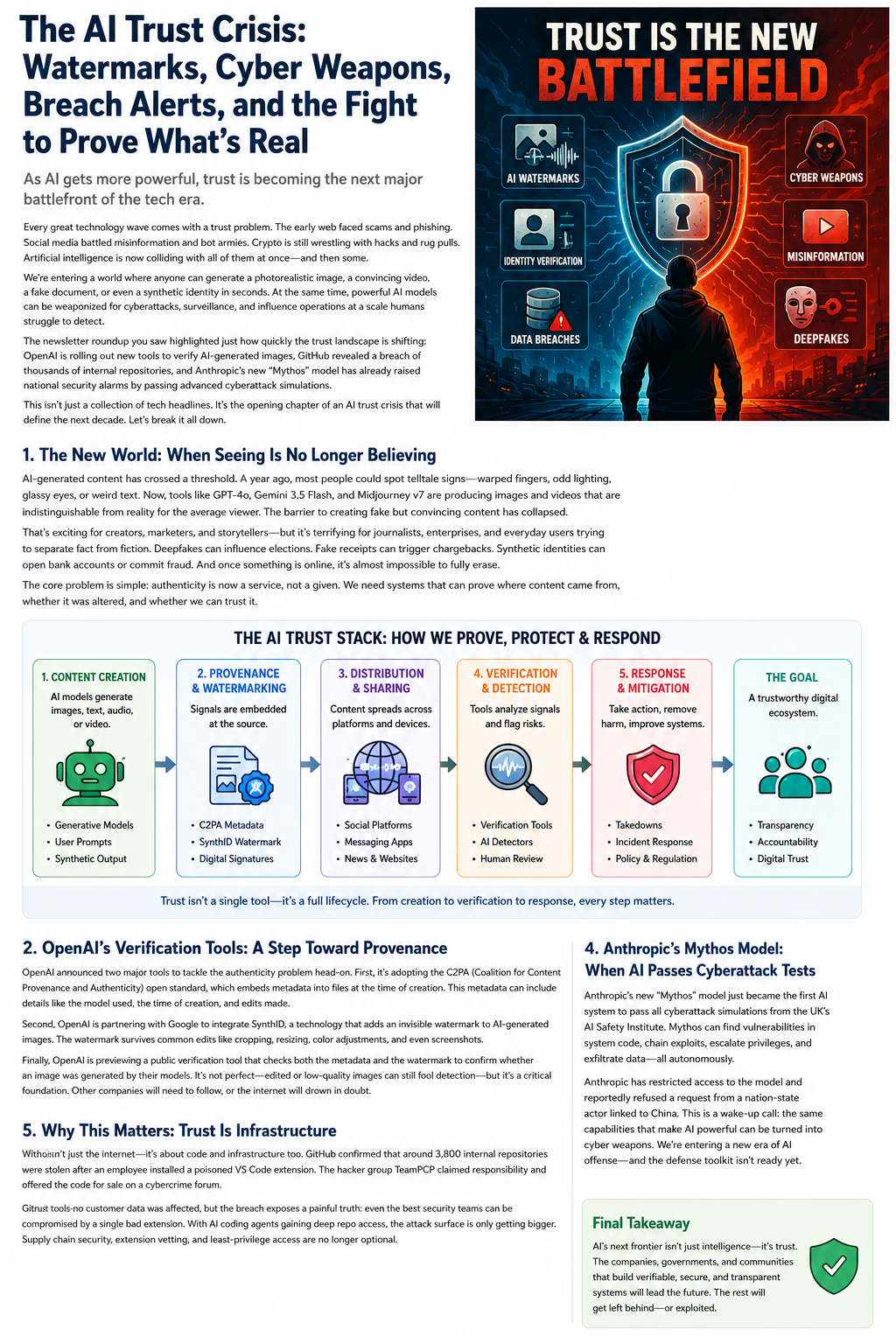
The newsletter material you collected points directly at this shift. In the same week, OpenAI rolled out new image verification tools using C2PA metadata and Google’s SynthID watermarking, GitHub confirmed a breach tied to a poisoned VS Code extension, Linus Torvalds complained that AI-generated bug reports were overwhelming the Linux security mailing list, and Anthropic’s restricted Claude Mythos model was framed as powerful enough to change the cybersecurity balance. The common thread is not just “AI is improving.” The common thread is that trust itself is becoming infrastructure.
What Is the AI Trust Crisis?
The AI trust crisis is the growing difficulty of knowing whether digital content, software, identities, security reports, and online interactions are authentic, altered, synthetic, or malicious. It is not one problem. It is a stack of problems. Some are media problems, such as deepfakes, fake photos, synthetic audio, and AI-generated news clips. Some are cybersecurity problems, such as AI-assisted vulnerability discovery, poisoned developer tools, automated phishing, and agentic malware. Some are governance problems, such as deciding who gets access to powerful models and what kind of proof companies must provide when AI touches content or code.
This crisis is different from earlier internet trust problems because AI lowers the cost of plausibility. A scammer no longer needs to be a great writer to produce a convincing message. A propaganda operation no longer needs a large studio to create persuasive visuals. A cybercriminal no longer needs to manually inspect every target if AI can help triage code, generate exploit ideas, or automate reconnaissance. Even ordinary users can create content that once required specialized skill, which is wonderful for creativity but dangerous when verification systems lag behind.
The deeper issue is that our old trust signals are breaking. We used to rely on rough clues: awkward grammar, strange lighting, fake-looking faces, suspicious email formatting, weird URLs, or amateur editing. Those clues still matter, but they are weaker every month. Synthetic content is getting cleaner. AI-written messages are getting more natural. Voice cloning is improving. Image models are fixing their obvious flaws. Code agents are becoming more capable. The more polished the outputs become, the less humans can rely on instinct alone.
This is why content provenance, watermarking, verification, software supply-chain security, model access controls, and AI audit trails are becoming central topics. These are not boring compliance details. They are the new trust layer of the internet. If AI makes creation nearly frictionless, then society needs better ways to prove origin, chain of custody, and intent.
Why People Are Fascinated by This
People are fascinated by the AI trust crisis because it hits a primitive fear: what happens when seeing is no longer believing? The internet already trained people to doubt screenshots, viral claims, edited clips, and out-of-context posts. AI pushes that skepticism into stranger territory. Now a realistic image may be synthetic, a real painting may be dismissed as AI slop, a voice recording may be cloned, and a software vulnerability report may be generated by a tool that does not understand the system it is reporting on.
This creates a strange double problem. On one side, fake content becomes easier to make. On the other side, real content becomes easier to deny. That second part may be even more dangerous. If every damaging video can be called a deepfake, every leaked document can be called synthetic, and every inconvenient recording can be dismissed as AI-generated, then trust does not merely weaken. It becomes negotiable.
For tech enthusiasts, the fascination also comes from the fact that this is not a purely cultural issue. It is technical. The solution is not simply “teach people to be careful online.” That helps, but it is not enough. The next layer of trust will involve cryptographic provenance, metadata standards, watermarking, browser-level verification, social platform labeling, AI model policy, cybersecurity disclosure rules, and enterprise security controls. This is a systems problem.
That is what makes the moment so important. AI trust is not a side debate for ethicists or policy people. It is becoming part of the product stack. If you build AI tools, publish content, run a website, manage a software team, operate a business, or depend on online reputation, this affects you directly.
The Trust Stack: How AI Authenticity Actually Works
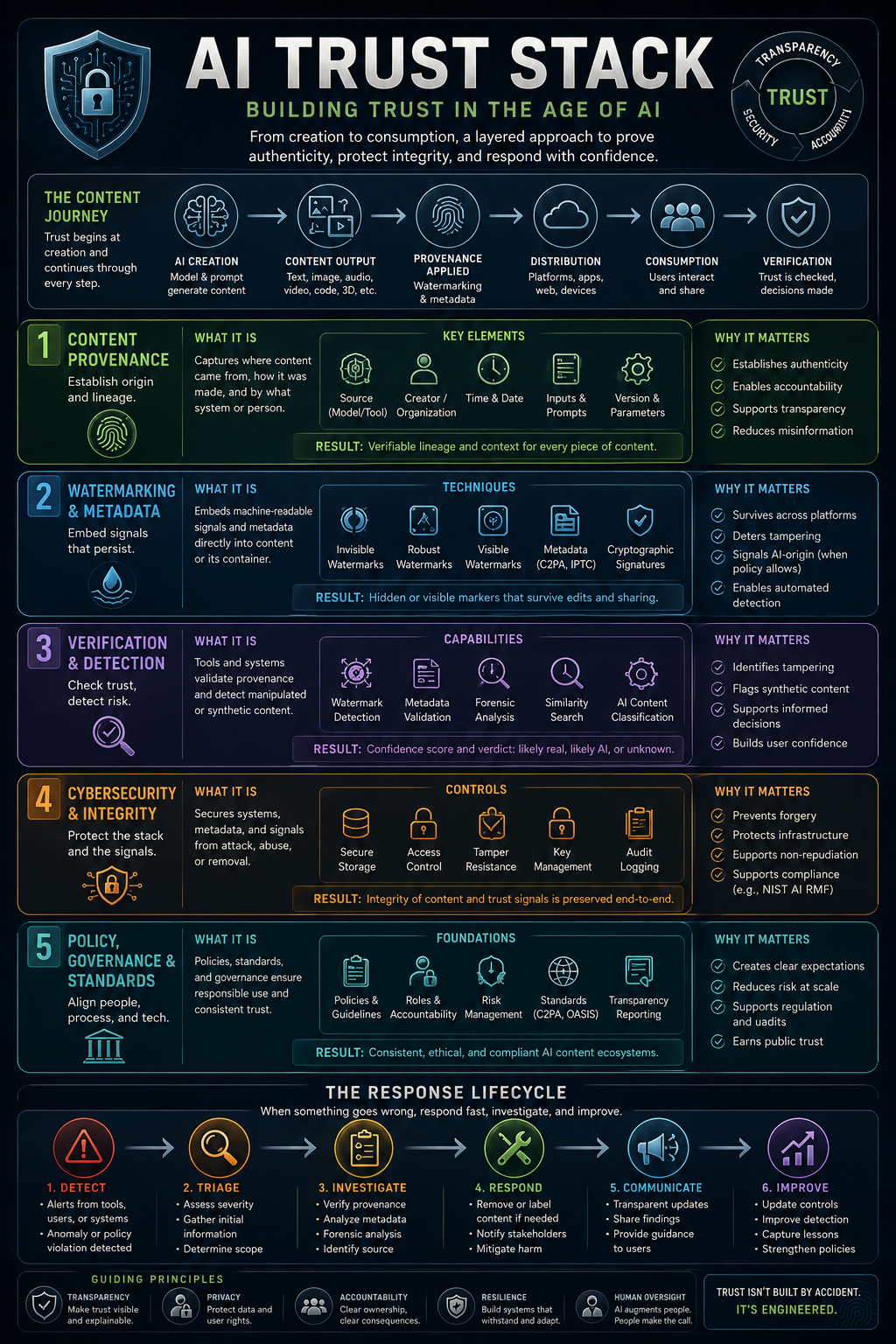
The first serious response to the AI trust crisis is provenance. Provenance means knowing where something came from, how it was created, and whether it was changed. In the AI media world, this usually means attaching signals to content at the time of creation so later systems can inspect those signals and tell users whether the image, video, or audio was AI-generated or edited.
C2PA, short for the Coalition for Content Provenance and Authenticity, is one of the main standards in this space. It allows content credentials to be attached to files as metadata, recording information about how the content was made or modified. OpenAI says it is adding C2PA Content Credentials and SynthID watermarks to images created in ChatGPT, Codex, and its API, while also launching an early verification tool to help people check provenance signals.
SynthID takes a different but complementary approach. Instead of relying only on metadata, it uses invisible watermarking designed to survive common edits such as cropping, compression, resizing, and screenshots. Google says it is expanding tools that help people understand how content was created and edited across the web, including wider support for SynthID and content credentials.
The key point is that no single method is perfect. Metadata can be stripped. Watermarks can be attacked. Detection tools can produce false positives or miss altered content. Platforms may fail to preserve signals. Bad actors can use open-source models that do not mark outputs. Screenshots can break the chain. The answer is not one magic detector. The answer is a layered trust stack.
OpenAI’s Verification Push: A Step Toward Provenance
OpenAI’s move toward stronger provenance is important because OpenAI-generated images have become widely distributed across the web. According to OpenAI’s own announcement, images generated through ChatGPT, Codex, and its API now include both C2PA Content Credentials and SynthID watermarking signals, and OpenAI has released a public verification tool for checking whether an image contains those signals.
This is a meaningful step, but it should not be oversold. Verification works best when the content was generated by a participating system, the provenance signals survived distribution, and the verifying tool recognizes them. That is a narrower condition than many casual readers assume. A verification tool that works for OpenAI-originated images is useful, but it does not solve the entire synthetic media problem.
The real value is precedent. If major AI labs begin embedding provenance signals by default, the industry moves closer to a world where reputable tools leave a trace. That trace does not stop all misuse, but it gives platforms, journalists, courts, researchers, and users something to inspect. In a world of infinite synthetic content, even partial provenance is better than pure guesswork.
There is also a business angle. Companies that generate AI content may eventually need to prove where that content came from. Advertisers may want clean provenance. Newsrooms may require it. Courts may examine it. Social networks may label it. Enterprises may insist on it for compliance. The companies that build provenance into their tools early may have an advantage as trust requirements tighten.
The Cybersecurity Side: When AI Finds Bugs Too Fast
The AI trust crisis is not only about images and deepfakes. It is also about software. AI is becoming useful at vulnerability discovery, code analysis, exploit research, and bug reporting. That is good news when defenders use it responsibly. It is bad news when the output floods maintainers, creates noise, or gives attackers more leverage.
Linus Torvalds’ complaint about AI-generated bug reports is a perfect example. Reports said he described the Linux security mailing list as “almost entirely unmanageable” because AI-assisted bug hunters were submitting duplicate reports, often for issues already known or fixed. The Register reported that Torvalds pushed back against private-list handling for many AI-found bugs and argued that reporters should read the documentation and write patches instead of generating churn.
This is an underrated problem. AI can make vulnerability discovery more accessible, but if every researcher sends automated reports without validation, maintainers drown in noise. Open-source security depends on scarce human attention. If AI tools generate ten thousand plausible but low-value reports, they do not strengthen security. They consume the time of the very people who fix real problems.
The lesson is broader than Linux. Every software project will need policies for AI-generated reports. Maintainers need to know whether a report was human-validated, whether a proof of concept exists, whether the affected version is current, whether the issue is duplicate, and whether the reporter understands the impact. AI can help find bugs, but responsible disclosure still requires human discipline.
Claude Mythos and AI as a Cyber Weapon
Anthropic’s Claude Mythos Preview shows the high-stakes version of the same issue. Anthropic describes Mythos Preview as a powerful model with advanced cybersecurity capabilities, made available through Project Glasswing for defensive cybersecurity work. Anthropic’s Transparency Hub says Mythos Preview is being made available to a limited set of partners for defensive cybersecurity purposes only.
That limited release is revealing. It suggests that some models are now capable enough that ordinary public release may be too risky. Anthropic’s Project Glasswing frames the optimistic version: use powerful AI to help defenders find and fix flaws in critical software before attackers exploit them. That is a strong argument. If AI can discover vulnerabilities, then defenders should not refuse the tool while attackers quietly adopt it.
But the dual-use problem is obvious. A model that helps defenders find vulnerabilities can also help attackers find vulnerabilities. A model that can reason about exploit chains, privilege escalation, and insecure code paths is not just another productivity assistant. It is a tool that touches national security, critical infrastructure, and offensive cyber capability.
This is why access control matters. The most powerful cyber-capable models may become more like controlled infrastructure than consumer software. Access may depend on identity verification, institutional partnerships, logging, use restrictions, and national-security review. Some people will call that gatekeeping. Others will call it basic responsibility. Both views have weight, but pretending the issue is simple is not serious.
Software Supply Chains: The GitHub Breach Warning
The GitHub breach story is another piece of the trust crisis because it shows how fragile developer ecosystems can be. The newsletter material described GitHub confirming that around 3,800 internal repositories were stolen after an employee installed a poisoned VS Code extension, with the TeamPCP hacker group claiming responsibility and offering source code for sale. Cybernews reported that GitHub said the attacker’s claims of around 3,800 repositories were directionally consistent with its investigation, while GitHub stated it had no evidence of customer repositories being affected.
This matters because developer tools are high-trust environments. A code editor extension can see projects, files, terminals, credentials, tokens, environment variables, and internal systems. Developers install extensions to move faster, but every extension is also a possible supply-chain entry point. The more AI coding tools, local agents, plugins, MCP servers, browser helpers, and workflow automations developers install, the larger this attack surface becomes.
AI makes this more complicated. Developers are now adding tools that can read repos, execute commands, connect to cloud services, manage tickets, open pull requests, and interact with internal systems. That is incredibly useful, but it means security teams need tighter controls around tool provenance, extension permissions, package integrity, and credential isolation.
The harsh lesson is simple: the AI-native development environment is powerful, but it is also dangerous if treated casually. A poisoned extension in a traditional coding workflow is bad. A poisoned extension in an agentic workflow with broad access could be far worse.
Why Supporters Think the Trust Crisis Can Be Managed
Supporters of AI provenance and security tooling argue that this crisis is serious but manageable. Their case is that the internet has faced trust breakdowns before and responded with new protocols, standards, institutions, and norms. Spam filters improved email. HTTPS improved web security. Two-factor authentication improved account protection. Package signing improved software distribution. Content provenance and AI security standards could become the next layer.
There is reason to believe this can work partially. If major AI labs embed provenance signals, operating systems and browsers expose verification tools, social networks preserve metadata, and publishers adopt content credentials, users could gradually gain better trust indicators. Not perfect truth, but better signals. A browser could tell you whether an image has verified provenance. A newsroom could attach an authenticity chain to a photo. A platform could label AI-generated media more consistently.
In cybersecurity, AI could become a defensive advantage if access is controlled and outputs are validated. Anthropic’s Project Glasswing is built around that premise: use advanced AI to secure critical software and give defenders a durable advantage. AI-assisted code review, exploit detection, dependency analysis, fuzzing, and remediation could make software safer if teams build process around the tools.
The best version of this future is not anti-AI. It is pro-verification. AI generates, but it also labels. AI finds bugs, but humans validate and patch. AI agents act, but logs and permissions remain visible. AI media spreads, but provenance travels with it. The internet becomes more synthetic, but also more instrumented.
The Skeptical View: Verification May Always Lag Creation
The skeptical view is that verification will always be behind generation. AI creation tools are easy to distribute, modify, and run outside official channels. Open models can generate unlabeled outputs. Metadata can be removed. Screenshots can flatten provenance. Watermarks can be degraded or attacked. Bad actors have every incentive to avoid systems that reveal origin.
This is a strong argument. A perfect trust system would require cooperation across model providers, device makers, editing tools, browsers, social platforms, messaging apps, news organizations, and governments. That is a lot of coordination. The internet is messy, and voluntary standards often fail when platforms do not preserve them or users do not understand them.
There is also the risk of false confidence. If users believe a verification tool is definitive, they may trust content too easily when a signal is present or dismiss real content too quickly when a signal is absent. Absence of provenance does not automatically mean fake. Presence of provenance does not automatically mean honest context. A real image can still be misleading. A genuine screenshot can still be cropped. A verified AI image can still be used deceptively.
The darker skeptical view is that the trust crisis may create a permanent fog. People may become so exhausted by synthetic content that they retreat into closed communities, trusted brands, private networks, and identity-verified platforms. That could reduce some misinformation but also fragment the open web. Trust may become more centralized, more expensive, and more dependent on gatekeepers.
Why This Matters Today
This matters today because AI trust is not a future problem. It is already showing up in content creation, software development, cybersecurity, journalism, politics, education, finance, and everyday online life. The tools are moving faster than norms. The models are improving faster than verification systems. The public is being asked to navigate an internet where fake things look real and real things can be dismissed as fake.
For tech enthusiasts, this is a moment to get ahead of the curve. Learn what C2PA is. Understand SynthID. Pay attention to provenance tools. Watch how browsers, social networks, and operating systems surface authenticity signals. Follow how AI labs handle restricted cyber-capable models. Track how open-source communities respond to AI-generated bug reports. These details will matter more every year.
For website owners and publishers, this creates both risk and opportunity. Readers will increasingly value sources that show their work, cite sources properly, label AI use honestly, and maintain editorial trust. A site that becomes known for sloppy AI slop will lose credibility. A site that uses AI while keeping human judgment, sourcing, and verification visible can stand out.
For developers and businesses, the practical action is to harden the toolchain. Vet extensions. Minimize permissions. Rotate secrets. Use scoped tokens. Separate experimental AI tools from production credentials. Require audit logs for agents. Validate bug reports before forwarding them. Treat AI-generated security findings as leads, not conclusions.
Real-World Application: How to Build Trust in an AI-Heavy Workflow
The first practical rule is to preserve provenance wherever possible. If your workflow creates AI images, videos, documents, or marketing assets, keep originals, prompts, tool names, dates, and version history. Do not rely only on memory. A simple internal content log can save headaches later if you need to prove where something came from.
The second rule is to label AI use intelligently. You do not need to turn every article into a legal document, but you should be honest when AI materially contributes to images, synthetic voices, generated visuals, or automated analysis. Readers are not stupid. If they feel tricked, trust drops. If they feel informed, AI use can actually strengthen your brand.
The third rule is to tighten software supply-chain hygiene. Developers should not install random extensions into important environments without scrutiny. AI coding tools should have scoped permissions. Local agents should not have unnecessary access to secrets. Production credentials should not live where experimental tools can read them. Convenience is not worth a breach.
The fourth rule is to treat verification as a habit, not a one-time tool. A suspicious image may require metadata checks, reverse image search, source tracing, visual inspection, and context analysis. A security report may require reproduction, version checking, duplicate search, and human review. A model output may require citations and source validation. Trust is a workflow, not a button.
Final Verdict: Trust Is the New AI Battlefield
The AI trust crisis is not about panic. It is about realism. AI will keep getting better at generating content, writing code, discovering vulnerabilities, simulating identities, and operating through tools. That progress will create enormous value, but it will also break many of the weak trust assumptions the internet has relied on for decades.
The optimistic path is clear enough. Build provenance into content. Use watermarking where it helps. Preserve metadata. Give users verification tools. Restrict the most dangerous cyber-capable models. Harden developer supply chains. Require audit trails for agents. Teach people that AI outputs are useful but not automatically trustworthy.
The pessimistic path is also clear. Platforms ignore provenance. Users drown in synthetic media. Developers install dangerous tools casually. AI-generated bug spam overwhelms maintainers. Cyber-capable models leak or get misused. Every real event becomes deniable, and every fake event becomes plausible.
My view is that trust will become one of the main competitive advantages in AI. The companies that win will not simply be the ones with the most powerful models. They will be the ones that can prove what their systems did, where their content came from, how their agents acted, and why users should believe them.
AI made creation cheap. Now the world needs to make verification strong.
2 Relevant External Links
OpenAI’s official content provenance announcement explains its use of C2PA Content Credentials, SynthID watermarking, and an early image verification tool.
Anthropic’s Project Glasswing page explains how Claude Mythos Preview is being used in a restricted defensive cybersecurity initiative for critical software.