
Free Energy Explained: Can Water Cars, Atmospheric Electricity, and Spinning Machines Really Produce Power?
There is something deeply appealing about the idea of free energy.
Imagine a vehicle that runs on water, a small machine that pulls electricity from the air, or a spinning magnetic device that keeps producing power long after it was started. These ideas show up constantly in videos, forums, documentaries, and late-night rabbit holes online. Some are presented as lost inventions. Others are described as suppressed breakthroughs. A few are connected to claims about secret military technology, unidentified aerial phenomena, or technology supposedly far beyond what the public is allowed to see.
The reason these topics are so persistent is simple: energy is expensive, essential, and often confusing. Most people can understand a battery, gasoline, or a power outlet at a basic level. But once you start talking about electricity, magnetic fields, rotating mass, hydrogen, atmospheric charge, or resonance, it becomes easy for a device to look more mysterious than it really is.
That does not mean every unusual energy idea deserves to be laughed at. Curiosity is useful. Many important technologies began as strange-looking experiments. Solar panels, radio transmission, electric motors, and wireless charging would all have seemed unbelievable to someone a few centuries ago.
But there is a difference between keeping an open mind and switching off your critical thinking.
This article explores what “free energy” usually means, why water-powered car claims are so common, what atmospheric electricity can and cannot do, how spinning machines and magnets really behave, and what kind of evidence would be needed before a truly revolutionary energy device should be taken seriously.
What Do People Actually Mean by “Free Energy”?
The phrase “free energy” is used so loosely that it can mean several completely different things.
Sometimes, people mean energy that is free after the equipment is installed. Solar panels are a good example. Sunlight does not send you a monthly bill, but the panels, wiring, inverter, roof installation, batteries, and maintenance certainly cost money. The energy is not created from nowhere. It comes from the Sun.
Sometimes, people mean renewable energy. Wind, solar, hydroelectricity, geothermal energy, and tidal power all rely on natural processes. These sources can be extremely valuable because they do not require continuously buying gasoline, coal, or natural gas. But they still have a source. Wind is powered largely by uneven solar heating of the atmosphere. Hydroelectric power comes from water lifted by the water cycle. Tides are driven by the gravitational relationship between Earth, the Moon, and the Sun.
Sometimes, people mean recovered energy. A device might capture waste heat, braking energy, vibration, pressure changes, or radio-frequency energy that would otherwise be lost. That can be useful, especially in sensors, industrial systems, and electric vehicles. But recovered energy is not new energy. It is energy that was already present in the system.
Finally, some people use “free energy” to mean energy created without a fuel source, battery, sunlight, wind, heat difference, moving water, chemical reaction, or external electrical input. That is where the conversation runs directly into the laws of thermodynamics.
A machine can convert energy. It can store energy. It can move energy. It can recover energy that would have been wasted. It can make a small source of energy more useful through better engineering. But a machine cannot continuously produce more usable energy than it receives without a real source somewhere in the system.
That is not a matter of scientists being closed-minded. It is the basic accounting system of physics.
The First Question to Ask: Where Is the Energy Coming From?
Whenever you see an impressive energy device, the first question should not be, “Does it spin?” or “Does it light a bulb?”
The first question should be:
Where is the energy entering the system?
That sounds simple, but it is the question that separates engineering from illusion.
A device may be drawing power from a hidden battery, an electrical outlet, a ground connection, a capacitor, a solar panel, a fuel source, a temperature difference, compressed air, a spring, a rotating flywheel, a chemical reaction, or a nearby radio transmitter. It may also be running briefly on energy stored during an earlier phase of the demonstration.
A motor that keeps spinning after the switch is turned off is not necessarily making free power. It may simply be using energy stored in its rotating parts. A light bulb that stays lit for a few minutes does not prove that a generator has created energy. It may be powered by a battery, capacitor, or chemical source that has not been measured.
The more impressive the claim, the more carefully the full energy path needs to be measured.
That means measuring voltage, current, power factor when alternating current is involved, heat losses, battery charging and discharging, mechanical input, fuel use, and output over a meaningful amount of time. A dramatic ten-second demonstration is not the same thing as a verified energy system.
Can a Car Really Run on Water?
The “water-powered car” is one of the most common free-energy claims in history.
The idea is usually presented in one of two ways. In the first version, a vehicle supposedly splits water into hydrogen and oxygen, then burns or uses the hydrogen to power the engine. In the second version, water itself is described as the fuel.
The first version is technically possible in part. Water can be split into hydrogen and oxygen through a process called electrolysis. An electrical current is passed through water, usually with an electrolyte or specialized equipment, and the water molecules are separated.
The basic chemical reaction is:
2H₂O + electrical energy → 2H₂ + O₂
The hydrogen can then be stored and later used in a fuel cell or burned in an engine. A fuel cell combines hydrogen and oxygen to generate electricity, heat, and water. In simplified form, the reaction goes in the opposite direction:
2H₂ + O₂ → 2H₂O + energy
This is real science. Hydrogen fuel cells are real. Hydrogen-powered vehicles are real. Electrolyzers are real.
But this does not mean water is a free fuel.
The energy required to split water into hydrogen and oxygen must come from somewhere. If you use electricity from the grid, solar panels, wind turbines, or a generator, that electricity is the original energy source. The hydrogen is acting as an energy carrier, similar to a battery. It stores energy in chemical form so that it can be used later.
Think of hydrogen made from water like ice made from water. You can freeze water into ice, store it, and later use the ice for cooling. But the freezer had to use electricity to create the ice in the first place. The ice is useful, but it is not a free source of cold.
Hydrogen works the same way. It can be useful because it stores energy, can be transported, and can power certain machines. But hydrogen is not a magic loophole that allows a vehicle to get more energy out than was put in to produce and store it.
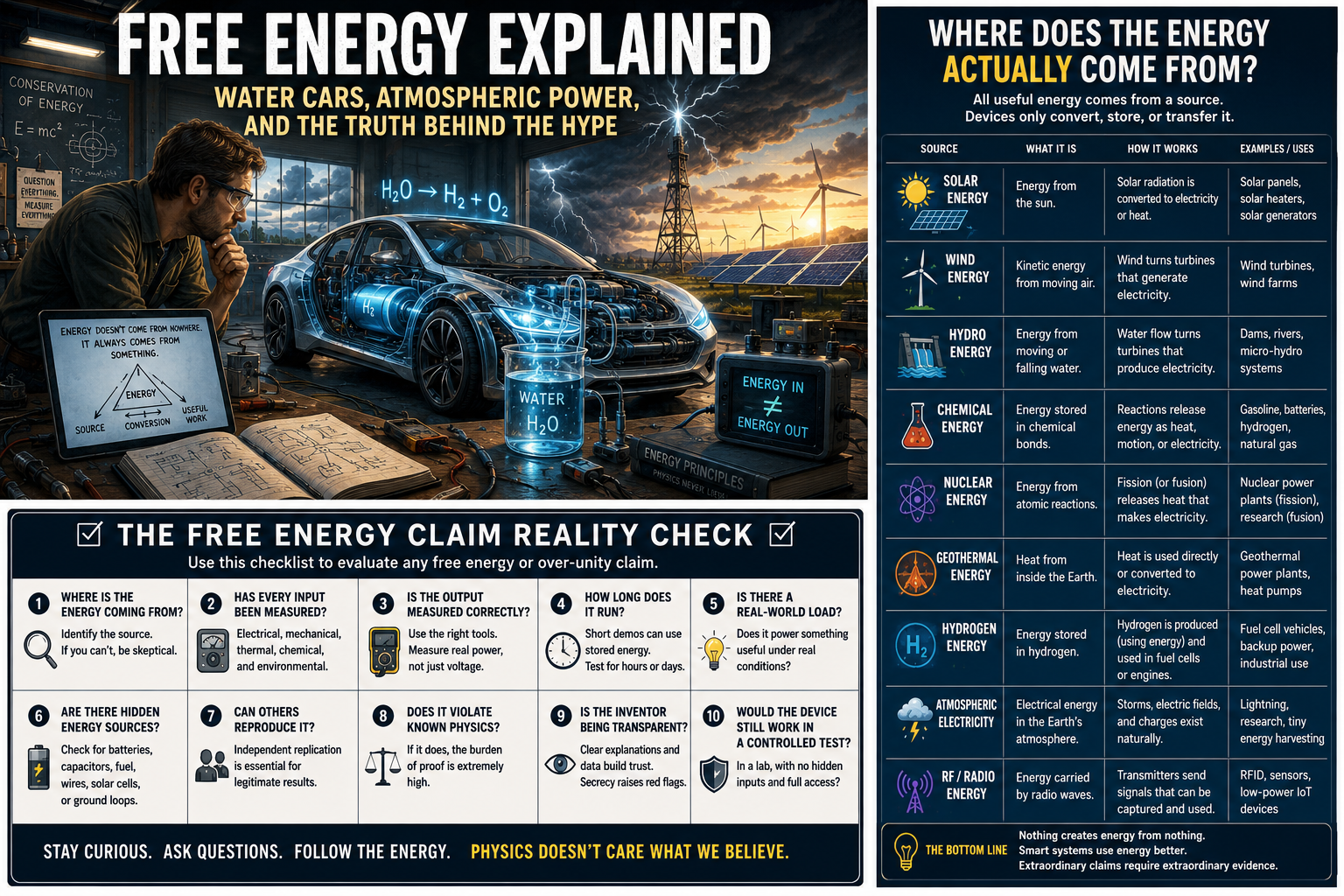
Why an Onboard Water-Splitting Car Does Not Close the Loop
A popular claim is that a car could use its own engine or alternator to split water into hydrogen while it drives, then use the hydrogen to keep itself running.
This sounds clever until you follow the energy loop.
Imagine a gasoline engine turning an alternator. The alternator generates electricity. That electricity powers an electrolyzer. The electrolyzer splits water into hydrogen. The hydrogen is then burned in an engine or converted back into electricity through a fuel cell. That output is used to help power the vehicle.
Every step has losses.
The engine loses energy as heat. The alternator is not perfectly efficient. The electrolyzer is not perfectly efficient. Compressing or storing hydrogen uses more energy. A fuel cell or hydrogen engine loses more energy. The electric motor, drivetrain, tires, and air resistance take more energy again.
By the time the energy completes the loop, less energy remains than was present at the start.
This is why an alternator-powered hydrogen system cannot make a car self-sustaining. The alternator creates electrical power by adding drag to the engine. That drag must be overcome with additional fuel or battery energy. The system may look active and impressive, but it is consuming energy from somewhere else.
Water can still play useful roles in vehicles. It can be used in cooling systems, steam systems, hydrogen production, water injection systems, and industrial processes. But water alone is not a fuel in the same way gasoline, diesel, hydrogen, or a charged battery can be.
Why Water Feels Like It Should Be an Energy Source
The confusion makes sense because hydrogen is an incredibly important element in energy science.
Hydrogen burns. Hydrogen can power fuel cells. Hydrogen is abundant in water. The Sun itself produces enormous energy through fusion reactions involving hydrogen.
So people naturally ask: if hydrogen is in water, why not just use water directly?
The answer is that hydrogen in water is already chemically bound to oxygen. In energy terms, water is a relatively stable end product. To separate hydrogen from oxygen, energy has to be added. You can absolutely do it, but you do not get a free bonus from the chemistry.
A useful comparison is wood ash. Wood can release heat when it burns because it contains chemical energy. After the wood has completely burned, the ash is not a new fuel source. Most of the easy-to-release chemical energy has already been used.
Water is not exactly the same as ash, but it is similar in the relevant sense: hydrogen and oxygen have already reacted to form a stable molecule. To pull them apart again, you need to put energy back into the system.
Can We Harvest Electricity From the Atmosphere?
This is where the free-energy conversation becomes more interesting.
The atmosphere is electrically active. Lightning, thunderstorms, static electricity, charged particles, the ionosphere, electromagnetic radiation, and Earth’s global electrical environment are all real scientific subjects. You can build devices that detect atmospheric charge. You can collect small amounts of energy from radio waves. You can use solar panels to capture electromagnetic energy that has traveled through space and the atmosphere.
So the claim that “there is electricity in the air” is not wrong.
The important question is how much usable power can actually be collected safely, continuously, and economically.
A high voltage does not automatically mean high power. Static electricity is a perfect example. You can sometimes feel a sharp spark after walking across a carpet and touching a metal object. That spark may involve a high voltage, but the total amount of energy is tiny. It is enough to surprise you, not power a refrigerator.
Power depends on both voltage and current. You need enough of each, in a usable form, for a useful amount of time.
Earth’s atmosphere has electric fields and electrical charge movement. Thunderstorms and lightning are dramatic evidence of that. But lightning is also dangerous, unpredictable, extremely brief, and difficult to capture without destroying equipment. A lightning strike can contain a tremendous burst of power, but converting that violent surge into reliable household electricity is a completely different engineering problem.
The atmosphere contains energy, but that does not mean it is a practical plug-and-play power outlet.
Atmospheric Electricity, Ground Connections, and Hidden Inputs
Some atmospheric-energy devices use tall antennas, grounding systems, capacitors, coils, or carefully arranged metal structures. These can produce measurable voltages. In some situations, they can collect small amounts of charge.
But a voltage reading alone does not prove the device can provide useful continuous power.
A sensitive meter can detect tiny electrical potentials that cannot run a meaningful load. A device may also be interacting with nearby power lines, radio transmitters, electrical wiring, underground currents, static charge, or electromagnetic interference. Even the act of measuring can introduce confusion if the equipment is not designed for the conditions involved.
Grounding is another common source of misunderstanding.
The ground is not a bottomless well of free electricity. A ground connection can serve as a reference point, a safety path, part of a radio antenna system, or one side of a circuit. But it does not create energy by itself. If a device appears to produce power through a ground connection, the full circuit needs to be understood. The energy may be coming from a voltage difference, an external transmitter, a nearby electrical system, chemical reactions in soil, or another source not being counted.
That does not make these experiments useless. They can be educational and can reveal real environmental energy. But they need honest measurements.
Radio-Frequency Energy Harvesting Is Real — Within Limits
One of the most legitimate forms of “power from the air” is radio-frequency energy harvesting.
Radio waves carry energy. Broadcast towers, Wi-Fi routers, cellular networks, radar systems, and other transmitters emit electromagnetic waves. An antenna can receive a portion of that energy. A circuit called a rectenna can convert some of the received radio-frequency signal into direct current electricity.
This is real technology.
The catch is scale.
A tiny sensor located near a strong transmitter may be able to collect enough energy to assist with low-power operation. A specialized system may harvest enough power for a sensor, remote monitoring device, RFID tag, or ultra-low-power electronics.
That is useful. In the right application, it can reduce battery changes or help power devices in difficult locations.
But it is not usually enough to run a home, charge an electric vehicle, or operate high-power tools. Radio transmitters spread energy across large areas, and the power density available at a typical location is limited. If you try to collect more energy, you need a larger antenna, a stronger nearby transmitter, better alignment, or a different source.
The energy is not coming from nowhere. It is coming from the transmitter that originally produced the radio waves.
What About Tesla Coils and “Power From the Air”?
Nikola Tesla is often brought into free-energy discussions, and for good reason: he was a brilliant inventor who worked on alternating current systems, high-frequency electricity, wireless transmission, motors, coils, and energy distribution.
But Tesla’s work is often mixed with claims that go far beyond what he demonstrated.
Tesla coils can create spectacular high-voltage electrical effects. Wireless power transfer is real. You can wirelessly charge a toothbrush, smartphone, or electric vehicle using carefully designed systems. But the power still has to come from a source. A wireless charger does not create electricity; it transfers electricity from a wall outlet or battery to another device.
The same rule applies to every wireless-power system: trace the input.
A coil, antenna, capacitor, or resonant circuit can make energy transfer more efficient under the right conditions. It can increase voltage. It can change frequency. It can store energy temporarily. But it does not eliminate the need for an energy source.
Can Spinning Machines Produce Free Power?
Spinning machines are another major category of free-energy claims.
You may see devices with heavy wheels, gears, magnets, pendulums, rotating arms, or unbalanced weights. Some are designed to look as though gravity or centrifugal effects are continuously helping the system spin.
The key concept here is that rotating objects can store energy.
A flywheel is a real energy-storage device. It is a heavy rotating mass that stores kinetic energy. The faster it spins, and the more mass it has concentrated away from its center, the more energy it can hold.
The stored rotational energy is often described by this formula:
E = ½Iω²
In that equation, E is stored energy, I is the moment of inertia, and ω is rotational speed.
A flywheel can be extremely useful. It can smooth power output, store short bursts of energy, stabilize electrical systems, support regenerative braking, and provide quick backup power. But it must first be spun up using energy. When it gives power back to a generator, it slows down.
A flywheel is more like a mechanical battery than an energy source.
If a flywheel appears to run for a long time, that can be impressive. It may have low-friction bearings, a vacuum enclosure, or a very efficient design. But eventually, friction, electrical load, and air resistance drain the stored energy unless another source keeps adding energy.
Centripetal Motion Is Not a Hidden Energy Source
The term “centripetal force” is frequently misunderstood in free-energy discussions.
Centripetal force is simply the inward force that keeps an object moving in a circular path. If you swing a ball on a string, the string pulls inward. That inward pull is the centripetal force. If the string breaks, the ball flies off in a straight-line direction because nothing is keeping it on the circular path.
Centripetal force is not a fuel. It is not a source of extra energy. It is a description of the force required to change an object’s direction while it moves in a circle.
Circular motion can look like it is producing something special because the object keeps moving. But maintaining or changing the motion involves forces, and extracting useful power creates resistance. If you connect a generator to a spinning system, the generator pushes back against the rotation. That is how generators work: mechanical energy is converted into electrical energy, and the rotating system loses energy unless an external source keeps driving it.
In other words, rotation can store energy and transfer energy. It cannot make the energy-accounting problem disappear.
Do Magnets Create Endless Motion?
Magnets can produce strong forces without touching. That makes them look almost magical.
A magnet can pull another magnet closer. It can attract metal. It can create torque in a motor. It can help levitate objects under carefully controlled conditions. It can turn a generator when the generator is driven by a turbine, engine, or other mechanical source.
But magnets are not a continuous source of free power.
A magnet can pull an object into a lower-energy position. The problem comes when you try to reset the system and repeat the cycle. To move the object back into its starting position, you have to put energy back in. Any clever-looking magnetic track, wheel, or arrangement still has to account for the energy needed to reset the magnets, weights, or moving parts.
Electric motors use magnets very effectively, but the energy comes from the electricity supplied to the motor. Generators use magnets very effectively, but the energy comes from the turbine, engine, hand crank, falling water, wind, or other mechanical input turning the generator.
Magnets are powerful tools for converting and controlling energy. They are not an energy source by themselves.
Resonance: Powerful, Useful, and Often Misunderstood
Resonance is another concept that can make a system look like it is gaining energy.
A swing is a simple example. If you push it at the right moment over and over again, the swing goes higher with relatively small pushes. The timing matches the swing’s natural motion. That is resonance.
Electrical circuits can also resonate. Mechanical systems can resonate. Buildings, bridges, antennas, musical instruments, and radio circuits all involve resonance in one form or another.
Resonance can make energy transfer more efficient. It can amplify motion or voltage under the right conditions. It can allow a small repeated input to build up a larger visible effect.
But the input still matters.
A resonant system can store and exchange energy between different forms, such as electric fields and magnetic fields in a circuit. It can appear dramatic because the energy is concentrated. But losses still exist. Resistance, friction, heat, and radiation slowly drain energy from the system unless an outside source continues feeding it.
Resonance is not proof of over-unity power. It is proof that timing and system design matter.
Why Some “Free Energy” Demonstrations Look So Convincing
Many free-energy demonstrations are not obvious scams. Some are honest mistakes. Others rely on incomplete measurement, confusing visual effects, or hidden assumptions.
Here are several common reasons a device can appear to create extra power:
- Stored energy is overlooked. Batteries, capacitors, compressed air, springs, heated materials, spinning rotors, and chemical reactions can keep a device running temporarily.
- Voltage is mistaken for power. A high-voltage reading can look impressive even when the available current is tiny.
- The electrical input is measured incorrectly. Alternating-current systems can be especially misleading if voltage, current, phase angle, and waveform shape are not measured properly.
- A hidden or uncounted energy source exists. This could be a battery, nearby radio transmitter, electrical outlet, solar cell, ground loop, fuel source, or a connection outside the camera frame.
- The test is too short. A device may work for seconds or minutes using stored energy but fail over hours or days.
- Output measurements are exaggerated. A light bulb glowing, a motor spinning, or a meter changing is not enough. The actual energy output needs to be measured accurately.
- The system is not independently tested. A serious breakthrough should work when qualified people outside the inventor’s group test it with their own instruments.
This does not mean every inventor is dishonest. It means extraordinary energy claims require better testing than ordinary claims.
What Would Real Proof of a Free-Energy Breakthrough Look Like?
A genuine device that reliably produces more useful energy than it receives would be one of the most important inventions in human history.
It would not need dramatic music, mysterious patents, secret workshops, or vague promises. It would need evidence.
A convincing demonstration would include:
- A complete description of every input and output.
- Independent testing by qualified engineers, physicists, and laboratories.
- Long-duration tests, not just short videos.
- Accurate measurements of voltage, current, power factor, mechanical input, heat losses, fuel use, and stored energy.
- Repeated results from multiple teams.
- A design that can be inspected closely enough to rule out hidden batteries, wires, chemical sources, and external power.
- A clear explanation of why the device does not violate established energy accounting.
Science is not hostile to new discoveries. Science is the process that turns a surprising claim into something the world can verify, reproduce, improve, and use.
What About Alien Technology or Secret Advanced Power Systems?
This is where the subject becomes more speculative.
Some people believe advanced energy technology already exists but is hidden by governments, corporations, military organizations, or non-human intelligence. Others connect unusual aircraft sightings or unidentified anomalous phenomena to propulsion systems that appear to ignore known physics.
It is understandable why people are curious. If an object seemed to accelerate rapidly, change direction instantly, or move without visible exhaust, it would naturally raise questions about propulsion and power.
But an unexplained observation is not the same thing as evidence of alien technology.
There are many possible reasons an observation may be unclear: limited data, distance, perspective, atmospheric effects, sensor limitations, classified aircraft, drones, balloons, natural phenomena, or simple misidentification. “Unidentified” means the available information was insufficient to identify it. It does not automatically mean extraterrestrial.
For a claim about alien energy technology to move beyond speculation, the evidence would need to be physical, measurable, and independently available for analysis. That could mean a device, material sample, power system, repeatable experiment, or complete data set that outside experts can inspect.
Until then, it belongs in the category of possibility and imagination, not established engineering.
The Real Future of Better Energy Is Already Interesting
The good news is that we do not need a perpetual-motion machine for energy technology to become dramatically better.
Real breakthroughs are happening through better solar cells, improved batteries, grid-scale storage, advanced nuclear reactors, geothermal systems, hydrogen production, heat pumps, smart grids, efficient motors, superconducting research, fusion research, and improved ways to capture wasted heat.
The most exciting energy technology is often less flashy than a miracle machine. It may look like a better inverter, a stronger battery chemistry, a more efficient motor controller, or a cheaper way to store energy overnight.
But those improvements matter. A few percentage points of efficiency across millions of homes, factories, cars, and devices can save enormous amounts of money and fuel.
The future may not arrive as a mysterious box that powers itself forever.
It may arrive as a world where energy is cheaper, cleaner, more local, more reliable, and used far more intelligently.
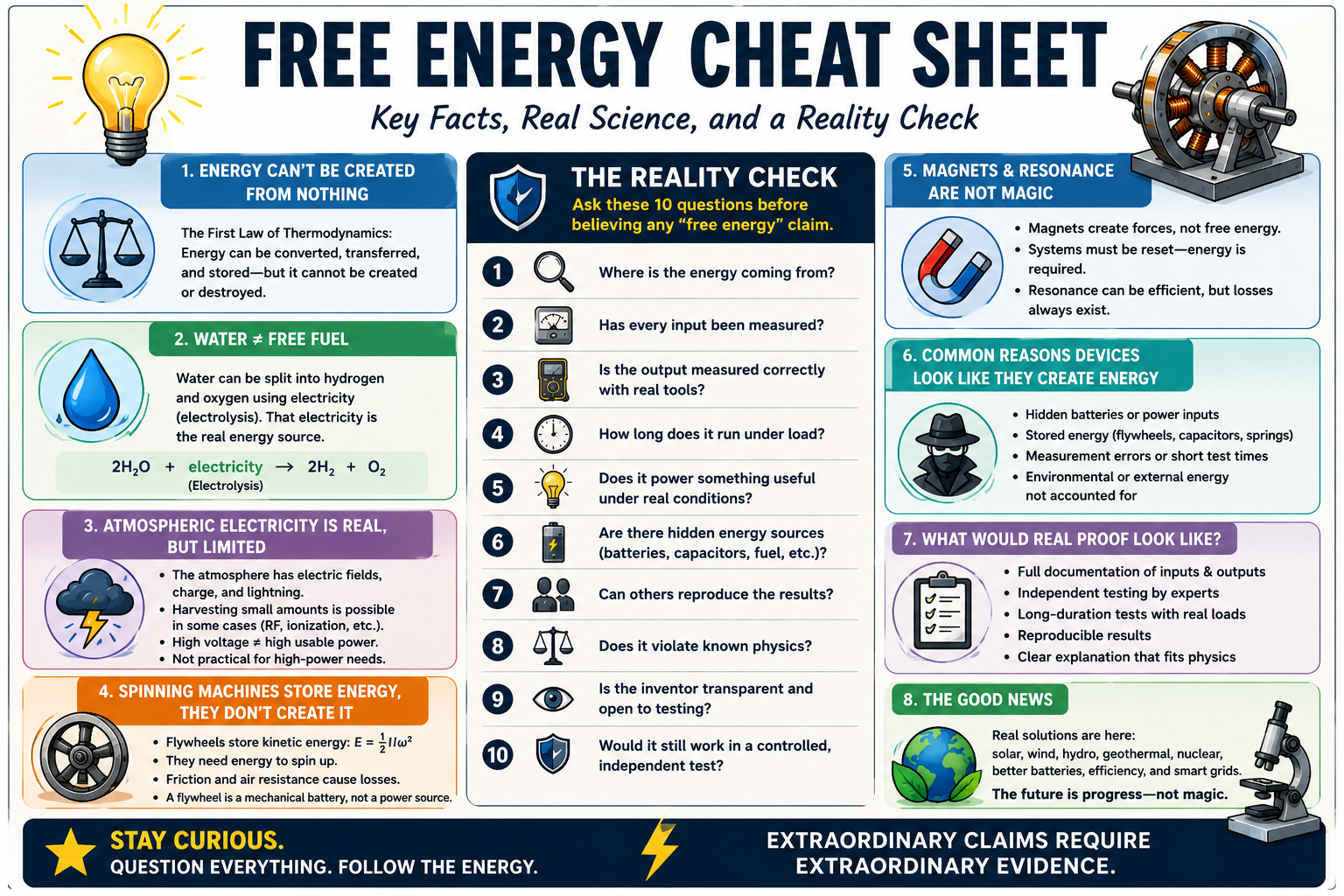
Free Energy Claim Reality Check
Before believing any free-energy claim, ask these questions:
- What is the actual energy source?
- Is the device converting energy, storing energy, or creating energy?
- Has every electrical, chemical, thermal, and mechanical input been measured?
- Is the demonstration running long enough to rule out hidden stored energy?
- Does the output stay useful when a real load is connected?
- Has an independent expert tested it?
- Can other people reproduce the result?
- Is the inventor explaining the system clearly, or relying mostly on mystery?
- Does the claim require ignoring basic energy losses?
- Would the device still work when all hidden wires, batteries, capacitors, fuel sources, and environmental inputs are removed?
A device that cannot answer these questions is not necessarily fake. But it has not earned the right to be called a breakthrough.
Final Thoughts: Stay Curious, but Follow the Energy
Free energy is one of those subjects where curiosity and skepticism need to work together.
It is absolutely worth exploring alternative energy, atmospheric electricity, hydrogen, wireless power, high-efficiency motors, flywheels, magnets, resonance, and new forms of energy storage. These are fascinating fields with real engineering value.
But the most important habit is to follow the energy.
Water can help produce hydrogen, but hydrogen production requires energy. The atmosphere contains electrical energy, but collecting useful power is difficult and limited. Flywheels can store energy, but they must be spun up first. Magnets can create force, but they do not remove the need to reset the system. Resonance can make a system more efficient, but it does not eliminate losses or create power from nothing.
A real energy breakthrough would be incredible. The standard for believing one should be high because the impact would be enormous.
Until that evidence arrives, the smartest position is not blind belief or automatic dismissal.
It is curiosity with a meter in your hand.
External Links
U.S. Department of Energy — Hydrogen Production: Electrolysis
Use it where you explain that electrolysis uses electricity to split water into hydrogen and oxygen.
NASA Earthdata — Atmospheric Electricity
Use it where you explain that Earth’s atmosphere is electrically active, while also clarifying that measurable atmospheric charge is not automatically practical household-scale power.
I think our best bet at free energy would be devising a way to pull energy from the atmosphere but the engineering feats required seem out of our current age’s expertise.